
Your washing machine has broken down, the technician has named a part and a price, and now you have to decide: repair or replace your washing machine? It is the question every owner faces sooner or later, and it is worth answering properly, because the wrong choice costs real money. Pay for a repair on a machine that fails again in three months, and you have spent twice. Replace a machine that only needed a $150 part, and you have spent several hundred dollars you did not need to spend.
There is no single answer, because the right choice depends on three things together: how old the machine is, what the repair costs, and what exactly has failed. A five-year-old washer with a failed drain pump is almost always worth fixing. A twelve-year-old washer with a failed drum bearing usually is not. This guide works through those three things in order, so you can make the decision with the numbers in front of you, not with a guess.
If you have not yet worked out what is wrong with the machine, start with the symptom guides first. A washer that leaves water standing in the drum is usually a drain or spin fault, a washer that shakes violently is usually a balance or suspension fault, and a washer that leaks is usually a hose, seal, or pump fault. Those guides are linked at the end of this article. This guide assumes you already know the fault, or the technician has told you what it is, and the question left is whether to fix it.
The Decision in Five Minutes
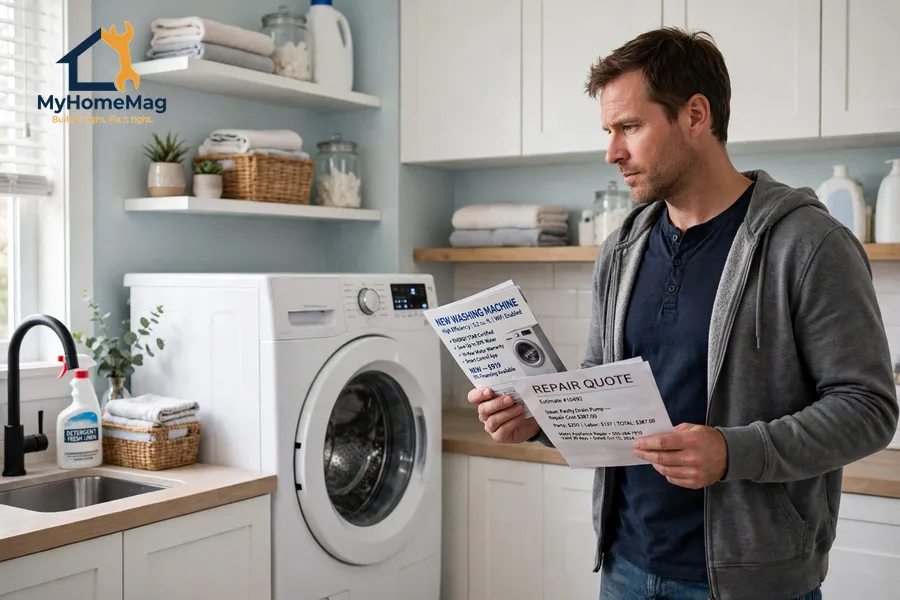
If you want the short version, here it is. Repair the machine when it is under eight years old, the repair costs less than half the price of a comparable new machine, the fault is a single worn part, and the machine has not needed another repair in the last year. Replace the machine when it is over ten years old, the repair costs more than half the price of a new one, the fault is the drum bearing or the control board on an old machine, or this is a second major repair in a year.
The middle ground — a machine between eight and ten years old, or a repair at about half the price of a new machine — is where the rest of this guide earns its keep. That is when the fault type, the machine’s history, and the running costs tip the balance one way or the other. Read the sections below in order, and by the end you will have a decision you can explain to the technician, not just a feeling.
The 50% Rule, Explained Properly
The rule most technicians quote is simple: if the repair costs more than 50% of the price of a comparable new machine, replace it. It is a good rule, but it only works if you compare the right numbers. The repair cost is the full fitted price — part plus labor plus the call-out fee — not the price of the part alone. The new-machine price is the price of a comparable machine, not the cheapest machine in the shop and not the top-of-the-range one. A basic top-load replacement costs far less than a large front-load with a steam cycle, and comparing your repair against the wrong machine makes the rule meaningless.
Work it with a real example. A new machine comparable to yours costs $800. The technician quotes $250 to replace the drain pump, fitted. That is about 31% of the replacement price, so the rule says repair. If the same machine needs a drum bearing at $550 fitted, that is about 69% of the replacement price, so the rule says replace. The rule is not a law — a machine you love, or one that fits a space no new machine matches, can be worth a repair above 50% — but it is the right starting point, and any decision to go against it should have a reason you can name. In this example, the $800 is the price of the machine itself, before installation and disposal, which the cost table lists as a separate $100-$250 line, while the repair quotes are fitted prices.
There is a second rule that matters just as much, and it is about age. A repair that makes sense at five years old often does not make sense at twelve, even at the same price. That is because an old machine is not just one repair away from working again. It is one repair away from working again until the next part wears out, and on a machine past ten years, other worn components may mean further repairs are more likely.
How Long a Washing Machine Should Last
A washing machine does not have a fixed expiry date, but it does have a realistic lifespan, and it differs by type. Use the table below as a planning guide, not a promise — a lightly used machine in a single-person home can outlast a heavily used family machine by years. The lifespans in the table are approximate planning estimates.
| Machine type | Typical lifespan | When repair usually stops making sense |
|---|---|---|
| Top-load, basic | 10–14 years | After about 10 years, or after a major repair |
| Top-load, high-efficiency | 10–12 years | After about 9 years, or after a control-board fault |
| Front-load | 10–13 years | After about 10 years, or after a bearing fault |
| Compact or portable | 8–10 years | After about 7 years, or when parts become hard to find |
Age matters because parts wear together. A suspension rod, a belt, and a drain pump on the same machine are all roughly the same age, and an older machine may have several worn components whose remaining service lives vary. That is why a machine that has already had one repair is more likely to need another soon. If your machine is under five years old, one repair is usually an isolated fault. If it is over ten and this is the second repair in a year, the machine is telling you it is wearing out as a whole, not failing in one place.
Parts availability is the other age problem. Spare-parts support varies by manufacturer, model, and component, and a model may be supported for about ten years. After that, a part may be out of production, available only as a used part, or priced so high that the repair stops making sense on cost alone. Before you authorize a repair on a machine over ten years old, ask the technician whether the part is still in production and how long it will take to arrive. A two-week wait for a part, with laundry piling up, is a real cost too.
Repair or Replace by Fault: What Each Breakdown Means
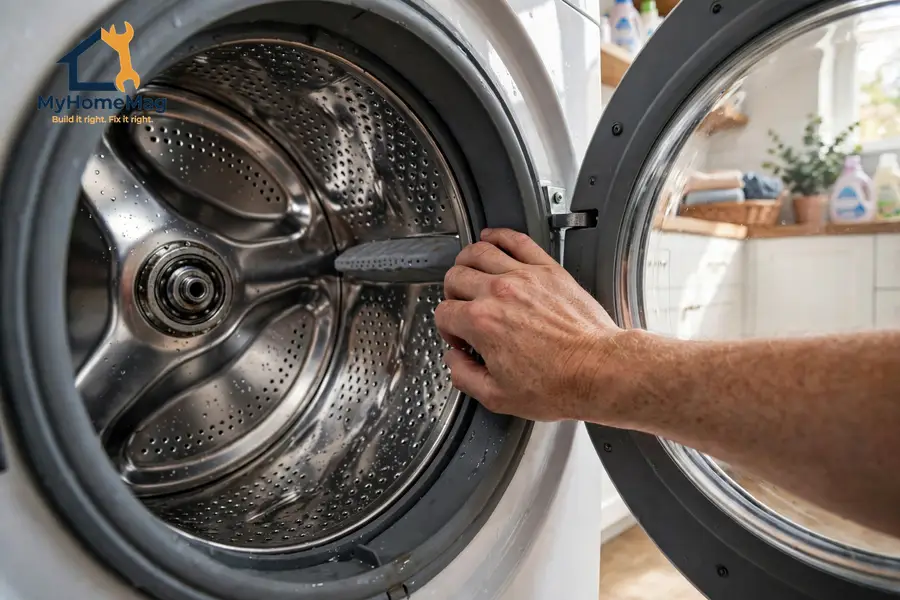
Not all faults are equal. Some are cheap, quick, and worth fixing on almost any machine. Others are expensive, disruptive, and often the sign that replacement is the better spend. The table below is the heart of this guide — find your fault, then read the age and cost sections with it in mind. The age thresholds in the table are approximate decision guidelines, not exact cut-offs.
| Fault | Usually repair | Usually replace | Why |
|---|---|---|---|
| Drain pump blocked or failed | Yes, at any age under 12 years (a starting point, not a final decision) | Rarely, unless the machine is very old | A common, contained repair; the machine is usually fine afterwards |
| Lid lock or door lock failed | Yes (a starting point, not a final decision) | Rarely | A safety part, cheap to fit, and a single-part fault |
| Drive belt worn or snapped | Yes (a starting point, not a final decision) | Rarely | One of the cheapest repairs; a belt is a wear item, not a sign of wider failure |
| Inlet valve or hoses leaking | Yes (a starting point, not a final decision) | Rarely | Usually a hose or valve, not the machine itself |
| Suspension rods or shock absorbers worn | Yes, under 8 years | Over 10 years, or with other faults | A real repair, but the machine can run well afterwards if it is otherwise sound. The 8-10-year range is the borderline decision range. |
| Control board failed | Under 7 years | Over 8 years, or if the board is out of production | The part is expensive, and a board failure can point to electrical wear elsewhere |
| Motor failed | Under 8 years | Over 10 years | A major part; on an old machine the next major part is usually close behind |
| Drum bearing failed | Under 7 years, and only if the quote is firm | Over 8 years, almost always | The most disruptive repair — the machine is stripped down to the drum — and the cost is close to a new machine. A bearing-only replacement is a different job from one that also involves a larger tub assembly. |
| Outer tub cracked or leaking | Almost never | Yes | A cracked tub is rarely worth the labor, and the repair may not hold |
| Multiple faults at once | Rarely | Yes | Two major faults together mean the machine is wearing out as a whole |
Two faults deserve a closer look, because they are the ones where owners most often spend money they regret. The first is the drum bearing. A failing bearing makes a grinding or roaring noise during spin, and the drum wobbles as it turns. Replacing it means stripping the machine down to the drum, and on some front-load models the bearing is pressed into the outer tub, so the tub assembly may have to be replaced too. That is why the fitted price is so high — and why, on a machine over eight years old, the money is almost always better spent on a replacement.
The second is the control board. A board failure can look like several faults at once — the machine will not start, or it stops mid-cycle, or the display shows an error that changes each time. A new board is expensive, and on an older machine the board may be out of production, which means a used board or a long wait. If the technician says the board is the fault and the machine is over eight years old, ask for the part price in writing before you agree to anything, and compare it against the 50% rule with the full fitted cost, not the part alone.
What Repairs Cost: Planning Ranges
All prices below are approximate US planning ranges only — they vary by model, region, and labor rates, and a quote from a local technician is the only firm price. Use them to test the 50% rule, not as a price you can hold a technician to.
| Repair | Approximate planning range, fitted | Notes |
|---|---|---|
| Drain pump replacement | $150–$300 | The most common washer repair; usually worth it |
| Lid lock or door lock | $120–$250 | A safety part — never bypass it to keep a machine running |
| Drive belt | $100–$200 | A wear item; cheap, and a sign of normal use, not failure |
| Inlet valve | $150–$300 | Often fixed with the hoses at the same visit |
| Suspension rods (top-load) | $150–$350 | Worth it under 8 years; check the drum bearing too |
| Shock absorbers (front-load) | $150–$300 | Usually replaced in pairs |
| Motor replacement | $250–$450 | Worth it under 8 years; over 10, compare with a new machine |
| Control board | $300–$500 | Ask whether the part is still in production. This range is a fitted replacement price. |
| Drum bearing | $300–$600 | Often uneconomic on a machine over 8 years old. The $300-$600 range is for a labor-intensive job, and it covers both a bearing-only replacement and a replacement where the bearing is part of an integrated tub assembly. |
| New top-load machine | $600–$1,200 | Budget to mid-range, before installation |
| New front-load machine | $800–$1,500 | Budget to mid-range, before installation |
| Installation and disposal | $100–$250 | Hoses, delivery, and removal of the old machine |
Read the repair column against the replacement column, not in isolation. A $300 repair on a machine that would cost $1,200 to replace is 25% — a clear repair. The same $300 repair on a machine that would cost $600 to replace is 50% — the borderline, where age and history decide. And remember the call-out fee: some technicians charge $50 to $100 just to diagnose the fault, and that fee may be charged separately or combined with the repair price, and whether it is credited if you go ahead with the repair depends on the provider. Ask before the visit, so the diagnosis does not become a sunk cost that pushes you toward a repair you would not otherwise choose.
The Hidden Costs on Both Sides
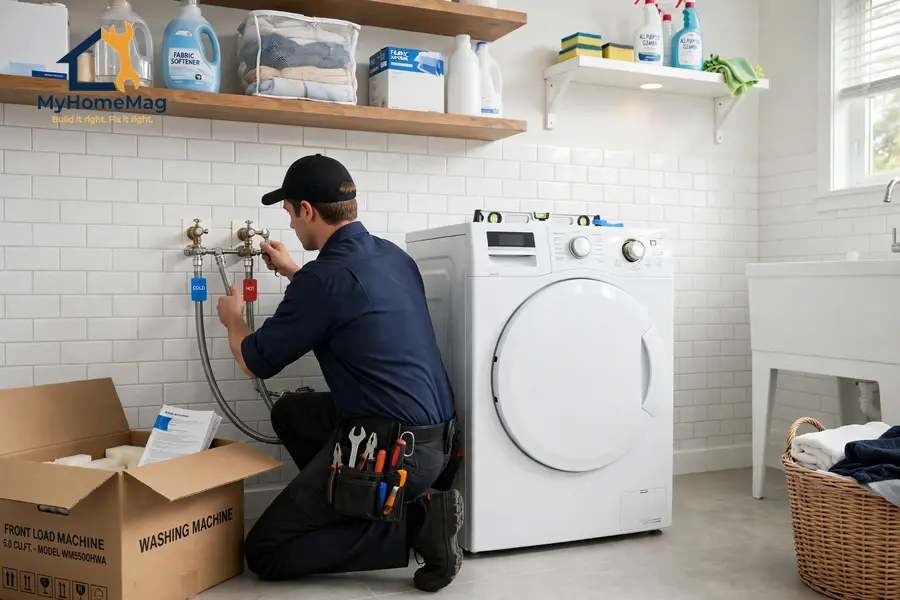
The repair quote and the new-machine price are not the only numbers. Keeping an old machine has running costs that a new machine does not, and buying a new machine has one-off costs that a repair does not. Both belong in the decision.
On the repair side, the hidden cost is efficiency. A machine over ten years old typically uses more water and more electricity per load than a modern machine of the same type, and it spins less efficiently, so clothes come out wetter and take longer in the dryer. The difference is not huge on one load, but over a year of family laundry it adds up — and it is a cost that continues every year you keep the old machine. An old machine is also more likely to need another repair, and the risk of further repairs is higher, and each visit carries its own call-out fee. Two $250 repairs in a year cost more than one $400 repair, and they cost more than the difference between repairing and replacing.
On the replacement side, the hidden costs are the ones around the machine, not in it. Delivery and installation, new inlet hoses, removal and disposal of the old machine, and — for a front-load machine — a pedestal or a stacking kit, if yours needs one. A new machine may also need different hookups: a front-load machine in the place of a top-load machine may need the drain hose re-routed, and a machine that is a different size may need the space adjusted, depending on the models and the existing hookups. Ask for the full installed price, including hoses and disposal, before you compare it with the repair quote. A $700 machine with $200 of installation and disposal is a $900 decision, not a $700 one.
There is one more cost that does not appear on any quote: the laundry that piles up while you wait. A repair that needs a part ordered in can leave you without a machine for a week or more. A replacement can usually be delivered in a few days. If you have no laundromat nearby, or a large household, that waiting time is worth weighing — and it is worth asking the technician, before you decide, how long the part will take to arrive.
Safety First: Before You Decide Anything
A washing machine that is faulty is still a machine full of water and mains electricity, and the safety rules apply while you are deciding, not just while it is being repaired. Unplug the machine before you look inside it, remove a panel, or touch any wiring, and turn the water supply off at the wall valves if the machine is leaking or the hoses look damaged. Never reach into a spinning drum, and never bypass the lid lock or door lock to “test” a spin — those locks exist because a spinning drum can injure a hand in a fraction of a second. Never bypass a thermal fuse or any safety device to keep a machine running while you decide. If you see sparking, smell burning, or find water pooling around the base, stop, turn the water off, and call a professional. Do not touch the plug or the machine if water may have reached the plug, socket, or floor; switch the power off at the breaker only if it can be reached safely. Some internal components can still hold a charge after the machine is unplugged, so do not open electrical components or attempt internal electrical repairs without appropriate training.
If the machine has walked across the floor or shaken violently, check the hoses behind it before you run it again. A pulled hose can leak, and a kinked drain hose can flood the room. And do not run repeated test cycles on a machine that is grinding, roaring, or shaking violently just to see whether it gets worse. Each cycle wears the fault further, and a drum bearing that seizes during a test spin can worsen the damage and potentially damage other components.
Questions to Ask the Technician Before You Authorize a Repair
The decision is easier when the quote is complete, and the way to get a complete quote is to ask for it. Before you authorize any repair, ask the technician these questions, and expect straight answers to all of them.
First, what exactly has failed, and is it a single part or a symptom of wider wear? A failed drain pump is a single part. A failed motor on a machine that also has a worn bearing is wider wear, and the quote should say so. Second, what is the full fitted price — part, labor, and call-out — and is the call-out fee waived if I go ahead? Third, is the part still in production, and how long will it take to arrive? Fourth, what warranty comes with the repair — on the part, and on the labor — and for how long? A repair with a 90-day warranty on a ten-year-old machine is a different proposition from the same repair with a one-year warranty.
Fifth, what else is likely to fail soon on a machine of this age? A good technician will tell you honestly if the suspension is worn as well, or the inlet valve is on its way out. Sixth, and most useful of all: if this were your machine, at this age, would you repair it or replace it? Technicians answer that question every week, and their answer — with the reason — is often the clearest guide you will get. If the answer is “replace it,” ask what the technician would buy in your place, and why. That is not a sales pitch; it is the opinion of the person who has seen the inside of your machine.
What to Check Before You Decide
Before you call a technician at all, work through the free checks in the symptom guides, because the fault you think you have may not be the fault you actually have. A machine that will not drain may only need its filter cleaned. A machine that shakes violently may only need its load redistributed and its feet leveled. A machine that leaks may only need a hose tightened, but turn the water supply off first and follow the manufacturer’s instructions, and remember that work around water and electricity needs safe isolation. Those are free fixes, and they change the decision completely — a machine that only needed a filter clean does not need a repair-or-replace decision at all.
If the free checks do not fix it, note the pattern before you call. When did the fault start — suddenly, or gradually over weeks? Does it happen on every load, or only on some? What noise does the machine make, and when? Does the drum turn smoothly by hand when the machine is unplugged and empty, or does it feel rough and wobbly? Roughness or wobbling can indicate a mechanical problem, but it needs professional confirmation. That pattern is what the technician needs to diagnose the fault quickly, and it is what separates a single-part repair from a machine that is wearing out. Tell the technician the machine type (top-load or front-load), its age, and what you have already checked, so the visit can focus on diagnosis instead of repeating the basic checks.
Your Quick Plan
- Work out the fault first, using the free checks in the symptom guides — a filter, a load, or a hose may be all it needs.
- Get a full fitted quote in writing: part, labor, and call-out fee, with the part’s availability and delivery time.
- Apply the 50% rule: compare the full repair price with a comparable new machine, installed.
- Check the age: under 8 years, repair usually wins; over 10, replacement usually wins; between 8 and 10, the fault type decides.
- Ask the technician what else is likely to fail soon, and what warranty the repair carries.
- If the fault is a drum bearing, a control board on an old machine, or a second major repair in a year, lean toward replacement.
- If you replace, get the full installed price — delivery, hoses, and disposal — before you compare it with the repair.
These steps are general guidelines, and the fault-specific recommendations and the machine’s total repair history take precedence. If you repair, keep the quote and the warranty, and note the date: if the same machine needs another major repair within a year, that is the point to replace it rather than pay twice. If you replace, keep the old machine’s manual and model number until the new one is installed and running, in case a hookup question comes up during installation.
Frequently Asked Questions
Should I repair or replace my washing machine?
Repair or replace your washing machine by comparing the full fitted repair cost with a comparable new machine. Repair it when it is under 8 years old, the repair costs less than half a new machine, and the fault is a single part. Replace it when it is over 10 years old, the repair costs more than half a new machine, or the fault is a drum bearing or a control board on an old machine.
How long should a washing machine last?
A washing machine usually lasts 10 to 14 years for a basic top-load machine, 10 to 13 years for a front-load machine, and 8 to 10 years for a compact machine. Light use extends that, and heavy family use shortens it. After about 10 years, parts can become harder to find for some models and manufacturers, and the risk of another repair is higher.
Is it worth repairing a 10-year-old washing machine?
It can be, for a cheap single-part repair such as a drain pump, a belt, or a lid lock — especially if the machine has had no other faults. It is usually not worth it for a drum bearing, a control board, or a motor on a 10-year-old machine, because the fitted repair cost can be close to half the price of a comparable new machine, depending on the actual fitted quote and the price of a comparable new machine, and another part is likely to fail soon.
What is the 50% rule for washing machine repair?
The 50% rule says: if the repair costs more than 50% of the price of a comparable new machine, replace the machine instead. Compare the full fitted repair price — part, labor, and call-out — with a comparable new machine, installed. It is a guide, not a law: a machine that fits a space no new machine matches can be worth a repair above 50%.
How much does it cost to repair a washing machine?
Common washing machine repairs cost about $150 to $300 fitted for a drain pump, $100 to $200 for a drive belt, $150 to $350 for suspension parts, and $300 to $600 fitted for a drum bearing. These are selected examples; see the main cost table above for motors, control boards, inlet valves, and door locks. All of these are approximate US planning ranges — a quote from a local technician is the only firm price.
When should I call a professional instead of deciding myself?
Call a professional when you do not know what has failed, when the machine makes a grinding or roaring noise, when you see sparking or smell burning, or when water is pooling around the base. Tell the technician the machine type, its age, and the checks you have already tried, and ask for a full fitted quote in writing before you authorize the work.
Related Guides
- MyHomeMag
- Appliance Guides
- Washing Machine Not Draining? Filter, Pump, and Hose Checks
- Water Stuck in Washing Machine? Won’t-Spin Checks to Try First
- Washing Machine Shaking Violently? Level It and Stop the Banging
- Washing Machine Leaking: Find the Source, Stop the Water, and Fix It Safely
- Dishwasher Leaking From Bottom: Door Gasket vs. Hose Problems
- Dishwasher Making Grinding Noise: Pump, Debris, and Motor Signs
11 Responses