A washing machine that shakes violently during the spin cycle is hard to ignore. The whole machine rocks, the drum bangs against the cabinet, and on a smooth floor it can walk a few inches across the room — sometimes far enough to pull on the hoses behind it. It sounds serious, and it can become serious if it is left alone, because every violent spin wears the suspension, loosens connections, and can damage the floor underneath.
The good news is that the most common causes are also the simplest. A washing machine shaking violently is usually out of balance, out of level, or still fitted with the parts that held the drum still in transit. Those are free checks, and they fix most cases. The harder causes — worn suspension rods, broken shock absorbers, or a damaged drum bearing — are technician jobs, but they are worth knowing about, because the pattern of the shaking tells you which one you are dealing with.
That distinction matters, because it changes where to look. If your washer will not spin at all, or leaves water standing in the drum, that is a different fault — a lid lock, drive, or drain problem — and it is covered in our companion guides on water stuck in a washing machine and a washing machine not draining. This guide covers the other case: the machine spins, but it shakes, bangs, or walks while it does so.
How the Spin Cycle Works — and Why Balance Matters
A spin cycle is the hardest work a washing machine does. The drum turns at hundreds of revolutions per minute to throw the water out of the clothes, and at that speed even a small imbalance becomes a large force. A single heavy towel bunched on one side of the drum can throw the whole machine off balance, and the faster the drum turns, the harder it shakes.
That is why washers are built to absorb movement. The drum hangs from suspension rods or springs on a top-load machine, or sits on shock absorbers on a front-load machine, and those parts soak up the normal wobble of a spin cycle. The feet underneath keep the machine level, so the drum turns true instead of leaning to one side. When any part of that system fails — a load bunched on one side, a foot that has wound itself loose, a suspension rod that has lost its damping — the wobble is no longer absorbed, and the machine shakes violently instead.
A new machine can shake for a different reason: the shipping bolts. Manufacturers bolt the drum in place for transport, so it cannot bounce around in the truck. If those bolts are left in, the drum cannot move at all during spin, and the whole machine shakes instead. It is one of the most common causes of violent shaking in a new washer, and it is also one of the easiest to miss.
Common Causes at a Glance
| Cause | What you notice | First fix |
| Unbalanced load | Shaking starts suddenly, on one load only | Redistribute the load, wash heavy items separately |
| Machine not level | Shaking on every load, worse on hard floors | Adjust the feet, check with a spirit level |
| Shipping bolts still in | New machine shakes violently from the first wash | Remove all bolts and fit the blanking caps |
| Worn suspension rods or springs | Drum hangs low on one side, shaking gets worse over weeks | Technician replacement |
| Worn shock absorbers | Banging on spin, machine rocks after the cycle stops | Technician replacement |
| Weak or uneven floor | Machine rocks even when level, floor flexes under it | Stiffen the floor or fit anti-vibration pads |
| Drum bearing failing | Grinding or roaring noise with the shaking | Technician job — often a repair-or-replace decision |
Safety First: Before You Touch Anything
A shaking washer still mixes water, mains electricity, and a fast-spinning drum. Use this short checklist before any check below:
- Unplug the washer before removing any panel, touching wiring, or reaching underneath it. Water and electricity do not mix, and a machine that shakes can pull a plug or a hose loose.
- Never reach into a spinning drum, and never open the lid or door to stop a violent spin by hand. Let the cycle finish or pause it with the controls, then wait for the drum to stop completely.
- Never bypass the lid lock or door lock to “test” a spin. Those locks exist because a spinning drum can injure a hand in a fraction of a second.
- If the machine has walked across the floor, check the hoses behind it before you run it again. A pulled hose can leak, and a kinked drain hose can flood the room. Turn the water supply off at the wall valves if a hose looks stretched or damaged.
- Do not run repeated spin cycles to test a violent shake. Each one wears the suspension further and can damage the drum. Run one test spin, note the pattern, and stop.
- If you see sparking, smell burning, or find water pooling around the base, stop, unplug the unit, turn the water off, and call a professional.
Check 1: The Load — the Cheapest Fix First
Start with the load, because it is the most common cause and it costs nothing to fix. A washing machine can only spin smoothly when the weight inside the drum is spread evenly. One heavy item — a bath mat, a single pair of jeans, a duvet — bunched on one side will throw the drum off balance, and the machine will shake until the spin slows down again.
Open the machine once the drum has stopped, and look at how the load sits. If everything is pressed to one side, spread it out by hand and run a spin-only cycle. If the machine runs smoothly with a balanced load, the machine was never broken. The habit to keep is simple: wash heavy items with other heavy items, never wash a single heavy item on its own, and add a couple of towels to a small load so the drum has something to balance against.
Also check the load size. An overloaded drum cannot distribute the clothes evenly, so it shakes even when the machine is level and the suspension is sound. Try a test load at about half the size you usually wash. If the smaller load spins smoothly, the fix is to wash in two smaller loads. And if the shaking only happens with one particular item — a waterproof mattress protector, for example — that item may be trapping water on one side of the drum, and it is better washed on a gentler cycle or by hand.

Check 2: Levelling Feet — the Fix Most People Skip
If the shaking happens on every load, not just one, check the levelling. A washer that is even slightly out of level leans to one side, and the drum spins off-centre. On a hard floor the machine will rock on its feet; on a wooden floor it can walk.
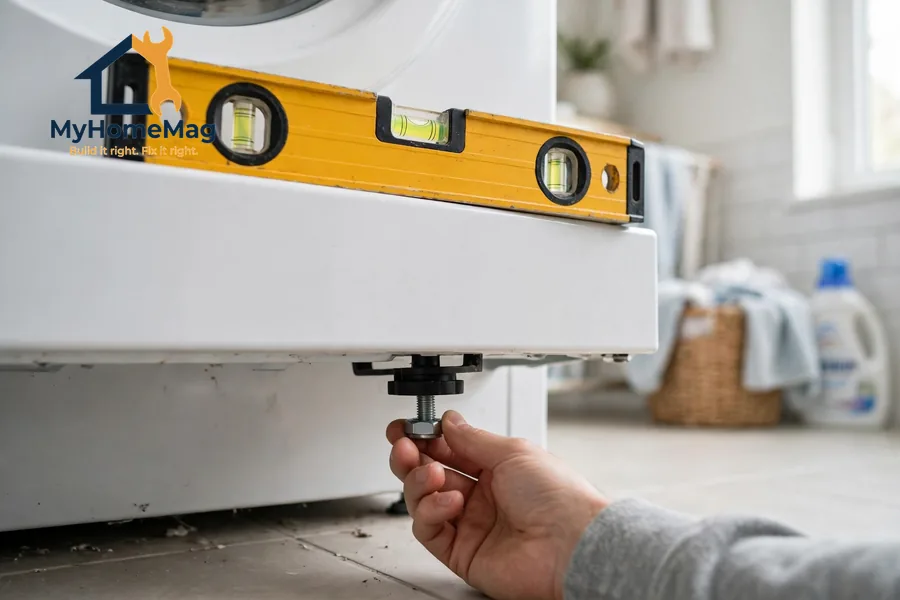
First, push the machine gently at each corner. If it rocks, one or more feet are not touching the floor. Then check with a spirit level, front to back and side to side, on the top of the machine. Adjust the feet underneath — they wind in and out — until the bubble sits in the middle in both directions, and tighten the lock nuts so the feet cannot wind themselves loose again. A foot that has worked loose is a common cause of shaking that starts gradually, weeks after the machine was installed.
Then run a test spin with a normal load. If the machine still rocks, check the feet again after the cycle — a violent shake can wind a loose foot out of adjustment. And if the machine sits on a pedestal or a raised platform, check that too: a pedestal that is not level, or not bolted to the machine, will amplify every wobble.
Check 3: Shipping Bolts — for a New Machine
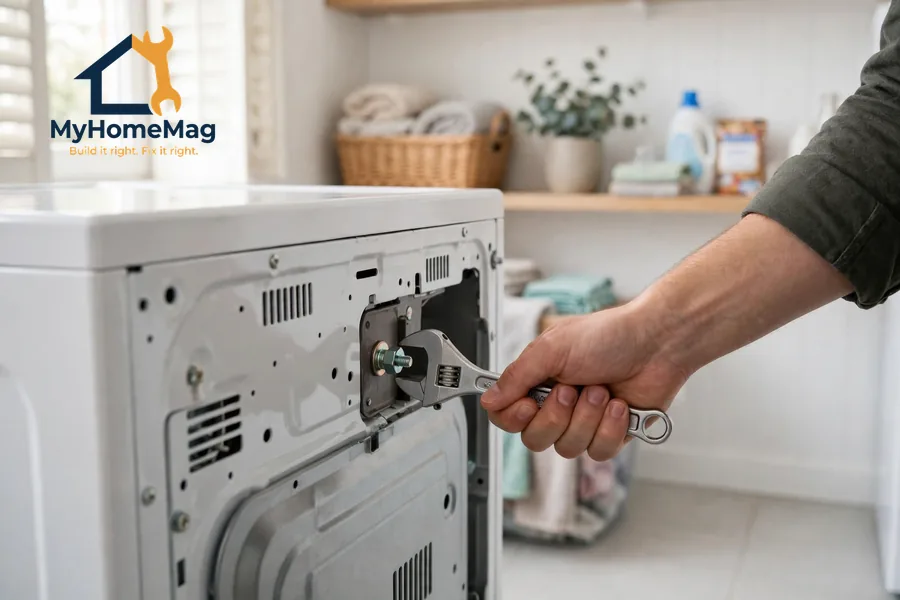
If the machine is new and it has shaken violently from the very first wash, check the shipping bolts before anything else. These are the bolts that hold the drum still while the machine is transported, and they must be removed before the first wash. If they are left in, the drum cannot move on its suspension at all, so the whole machine shakes instead — and running it like that can damage the drum and the suspension.
The bolts are at the back of the machine, usually four of them, and the manual shows exactly where they are. Unplug the machine, pull it out just enough to reach the back, and remove each bolt with a spanner. Keep the bolts somewhere safe — you will need them again if the machine ever moves house — and fit the blanking caps that came with the machine into the holes they leave.
Then run a test wash. If the shaking stops, the bolts were the problem, and the machine should now spin smoothly. If the machine was run for weeks with the bolts in, though, tell a technician: the suspension may have been damaged, and it is worth a check even if the shaking has stopped.
Check 4: Suspension Rods, Springs, and Shock Absorbers
If the load is balanced, the machine is level, and the bolts are out, but the shaking is getting worse over weeks, the suspension itself may be worn. On a top-load machine the drum hangs from suspension rods, each with a spring and a damping pad. On a front-load machine it sits on shock absorbers, like the ones in a car. Both wear out over time, and when they do, the drum can no longer absorb the normal wobble of a spin.
You can check this without opening the machine. With the machine unplugged and empty, push the drum down firmly and let go. On a top-load machine, the drum should bounce once and settle. If it keeps bouncing, or if it hangs visibly lower on one side, a suspension rod has lost its damping or broken. On a front-load machine, push the drum from side to side: it should move a little and return to centre. If it clunks, or stays off-centre, a shock absorber may have failed.
Do not try to replace suspension parts yourself unless you have done it before. The drum is heavy, the springs are under tension, and the machine must be opened up to reach them. This is a technician job, and it is one where the pattern you observed matters: tell the technician whether the shaking started suddenly or crept in over weeks, whether the drum hangs low on one side, and whether the machine also bangs when the spin stops. That separates a worn suspension rod from a broken shock absorber, and it means the visit starts with the right part.
Check 5: The Floor Underneath
Sometimes the machine is fine and the floor is the problem. A washing machine on a flexible wooden floor, or on a floor that slopes slightly, will shake more than the same machine on a solid concrete slab. The floor flexes under the spin, the machine rocks on the flex, and the shaking feeds on itself.
Check whether the floor moves. Stand beside the machine during a spin and watch the floorboards, or put a glass of water on the floor nearby and watch for ripples. If the floor flexes, try anti-vibration pads under the feet first — they are cheap, they grip the floor, and they absorb some of the movement. They will not fix a worn suspension, but they can turn a machine that walks into a machine that stays put.
If the pads do not help, the floor itself may need stiffening — extra joists, a plywood panel under the machine, or moving the machine to a ground-floor room with a solid floor. That is a bigger job, and it is worth a conversation with a contractor before you spend money on parts for a machine that was never the problem. And if the machine is in an upstairs laundry room, check that it is not sitting on a hollow platform: a platform that flexes will make any washer shake.
Check 6: Noises That Point to the Drum Bearing
A shaking washer that also makes a new noise needs a different kind of attention. Listen during the spin: a grinding, roaring, or rumbling sound that grows louder as the drum speeds up points to the drum bearing — the part the drum turns on. A bearing that is failing lets the drum wobble as it spins, and the wobble gets worse until the drum can seize.
You cannot fix a bearing yourself. Replacing it means stripping the machine down to the drum, and on many machines the bearing is pressed into the outer tub, so the repair costs almost as much as a new machine. That is why this check is about deciding, not fixing: note when the noise started, whether it is worse on a full load, and whether the drum feels rough or stiff when you turn it by hand with the machine unplugged and empty. If the drum turns roughly, or wobbles from side to side, call a technician with that pattern and ask for a repair quote before authorising the work — on a machine over eight or ten years old, replacement is often the better spend.
Call a professional if any of these apply: the drum hangs low on one side or bounces freely; the machine bangs even with a balanced load on a level floor; you hear grinding or roaring during spin; or the machine has walked far enough to pull on its hoses. Tell the technician what you have already checked — load, feet, bolts, floor — so the visit starts with the parts, not with the free checks.
What Repairs Cost, and When Replacement Makes More Sense
All prices below are approximate US planning ranges only — they vary by model, region, and labour rates, and a quote from a local technician is the only firm price.
| Repair | Approximate planning range | Notes |
| Levelling and load balance | Free | Feet adjustment and redistributing the load |
| Anti-vibration pads | $20–$50 | Worth trying before parts are replaced |
| Suspension rods (top-load) | $150–$350 fitted | The most common worn-part repair for shaking |
| Shock absorbers (front-load) | $150–$300 fitted | Usually replaced in pairs |
| Drum bearing | $300–$600 fitted | Often uneconomic on an older machine |
| New washing machine | $600–$1,200 | Budget to mid-range, before installation |
As a rule of thumb, if the repair costs more than half the price of a comparable new machine, and the machine is over eight years old or has had other faults, replacement is usually the better spend. A new machine also comes with a warranty, and modern machines spin more efficiently, so they leave clothes drier and cut drying time. If the machine is under five years old and the fault is a single worn part, repair is usually worth it.
Preventing Violent Shaking in the Future
Most violent shaking is preventable with three habits. First, load the drum evenly: mix heavy and light items, never wash a single heavy item alone, and do not overload the drum — a drum that is about three-quarters full spins more smoothly than one packed tight. Second, check the levelling feet once a year, and after any move: a foot that has wound itself loose is the quietest cause of shaking that gets worse over months. Third, clean the filter and check the hoses when you do the annual check — a machine that shakes can loosen a hose connection, and a small leak caught early is a much smaller job than a flooded floor.
For a new machine, keep the shipping bolts and the manual together, and run the first wash with a small load so you can hear whether the spin is smooth. And if the machine ever starts shaking after a period of smooth running, stop and check the load and the feet before you run another spin — every violent cycle wears the suspension a little further.
Your Quick Plan
- Stop the cycle, wait for the drum to stop, and redistribute the load. Run one test spin.
- Check the machine is level with a spirit level, front to back and side to side, and adjust the feet.
- If the machine is new, check the shipping bolts are out.
- Push the empty drum down and let go — if it keeps bouncing or hangs low on one side, the suspension is worn.
- Try anti-vibration pads if the floor flexes under the spin.
- If the shaking stays, or you hear grinding, call a technician with the pattern you saw.
If the machine spins smoothly after any step, run one full wash with a normal load to confirm the fix. If it still shakes violently, do not keep running test spins — call a technician with the machine type (top-load or front-load), the age of the machine, and the checks you already tried.
Frequently Asked Questions
Why does my washing machine shake violently during the spin cycle?
A washing machine shaking violently during the spin cycle is usually out of balance: the load is bunched on one side, the machine is not level, or the suspension can no longer absorb the spin. Check the load first, then the levelling feet, then the suspension — in that order, because the free checks fix most cases.
Why does my washing machine walk across the floor?
A washer walks when the shaking is strong enough to lift the feet off the floor, a little at a time, with each spin. The usual causes are an unbalanced load, feet that are not level, or a smooth, hard floor with no grip. Level the machine, balance the load, and try anti-vibration pads — and check the hoses behind the machine, because a walking washer can pull them loose.
Is it safe to keep using a washing machine that shakes?
A machine that shakes a little on one unbalanced load is usually safe once the load is fixed. A machine that shakes violently on every load is not safe to keep running: it wears the suspension, can damage the floor and the hoses, and can pull a water connection loose. Stop, work through the checks above, and call a technician if the shaking stays after the load and the feet are right.
Why is my new washing machine shaking?
A new washing machine shaking violently from the first wash almost always still has its shipping bolts in. Those bolts hold the drum still for transport and must be removed before the first wash. Remove all of them — usually four, at the back — fit the blanking caps, and run a test wash. If it was run for weeks with the bolts in, ask a technician to check the suspension.
When should I call a professional for a shaking washing machine?
Call a professional if the drum hangs low on one side or keeps bouncing when you push it down, if the machine bangs even with a balanced load on a level floor, or if you hear grinding or roaring during the spin. Those point to worn suspension parts or a failing drum bearing — both technician jobs. Tell the technician what you have already checked so the visit starts with the parts, not the free checks.
Related Guides
- MyHomeMag homepage
- Appliance Guides category
- Water Stuck in Washing Machine? Won’t-Spin Checks to Try First
- Washing Machine Not Draining? Filter, Pump, and Hose Checks
- Washing Machine Leaking: Find the Source, Stop the Water, and Fix It Safely
- Dryer Not Heating? Electric and Gas Checks to Try First