
Your fridge is humming. You can hear it running, and the freezer is still cold — yet the milk is warm and the fridge thermometer keeps climbing. A fridge not cold but freezer is pattern is easy to misread, because a running fridge feels like a working fridge.
It is not the same problem as a blocked vent or a dead fan. Those are covered in our companion guide, Fridge Not Cooling but Freezer Works, where cold air is made but never reaches the fridge. This guide covers the other half: the compressor side. When the compressor struggles, short-cycles, or keeps cutting out, the fridge loses cooling capacity first, because the freezer is smaller, better insulated, and gets the cold air first.
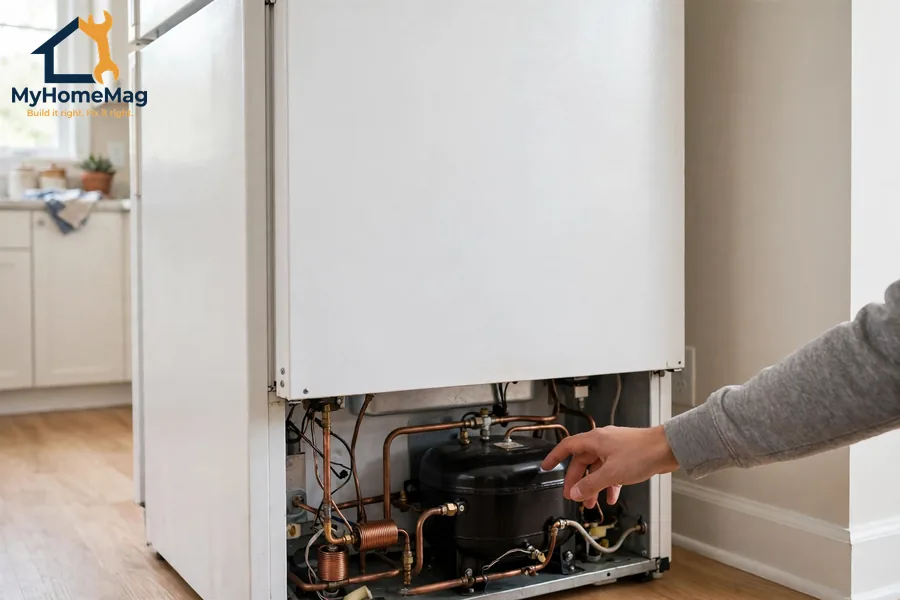
How Your Fridge Actually Makes Cold
A refrigerator does not make cold directly. It moves heat out of the box, and the compressor is the pump that does the moving. The compressor squeezes refrigerant gas, the condenser coils release the heat into your kitchen, and the evaporator coils inside absorb heat from the food compartments.
Three parts have to cooperate: the thermostat tells the system when to run, the start relay kicks the compressor on, and the condenser fan clears heat away from the coils. If any of them falters, the compressor may run briefly, click off, and try again — and the fridge warms up while the freezer, which needs less cooling to stay cold, holds on longer.
Signs the Compressor Side Is Struggling
A warm fridge with a cold freezer is the headline sign, but the supporting clues point to the compressor. Listen for clicking every few minutes, a hum that starts and stops, or a compressor that feels hot to the touch. Food spoiling early and a fridge temperature above 40°F confirm the problem is real, not a faulty thermometer.
Common Causes at a Glance
| Cause | What you may notice | First safe check |
|---|---|---|
| Start relay failure | Clicking every few minutes, compressor never stays on | Listen for the click pattern, feel for vibration |
| Compressor overheating | Compressor very hot, fridge cycles off early | Check airflow around the fridge, clean the coils |
| Thermostat or control fault | Fridge never calls for cooling, or runs at the wrong time | Test settings, listen for the compressor starting |
| Dirty condenser coils | Fridge runs longer, kitchen feels warm, fridge creeps up | Look at the coils underneath or behind |
| Condenser fan not running | Coils hot, compressor cuts out, fridge warms first | Listen for the fan near the compressor |
| Sealed-system problem | Partial frost pattern, fridge never reaches temperature | Note the frost pattern, then call a pro |
| Power or voltage problem | Lights dim, fridge resets, clicking after an outage | Check the outlet and the circuit |
| Overstuffed or blocked vents | Cold spots and warm spots (airflow, not compressor) | See the companion guide, not this one |
This table is a starting point, not a diagnosis. The checks below follow the same order.
Safety First: Before You Touch Anything
A refrigerator uses mains electricity, and the compressor area has hot surfaces and a capacitor that can hold a charge. Use this short checklist before any check in this guide:
- Unplug the fridge before touching the compressor, the relay, or any wiring. Do not work on live parts.
- Move perishables into a cooler with ice if the fridge is above 40°F.
- Do not work on the sealed refrigerant system: no cutting lines, no adding refrigerant, no opening the compressor.
- Never bypass a safety device, a relay, or an overload protector to force the compressor to run.
- If you smell burning, see sparking, or find damaged wiring, stop and unplug the unit.
Check 1: Is the Compressor Actually Running?
The first question is simple, and people get it wrong: the noise you hear may be a fan, not the compressor. The compressor is the low hum and gentle vibration at the back bottom of the fridge; the fans are a lighter whir.
Put your hand on the side of the fridge near the back, low down, while it is plugged in. A running compressor gives a steady, low vibration. If you feel nothing at all while the fridge is warm, the compressor is not running — move to Check 2. If it vibrates for a minute, stops with a click, then tries again a few minutes later, it is short-cycling, and the relay or overheating is the likely cause. A healthy compressor runs in long, steady stretches, then rests. Short bursts with clicks in between are not healthy.
Check 2: The Clicking — Start Relay and Overload Protector
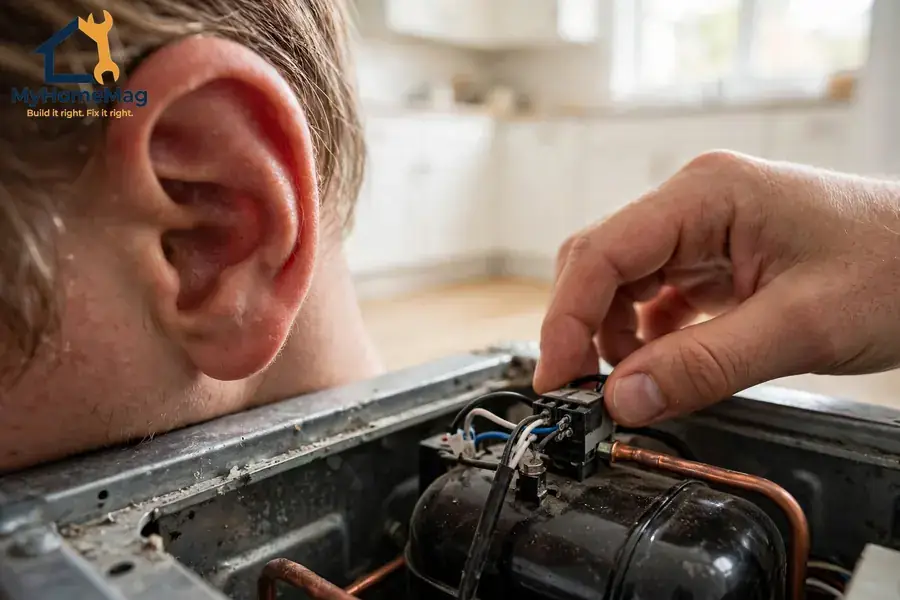
A click every two to five minutes, followed by silence, is the classic sign of a failed start relay or a tripped overload protector. The relay is a small part that gives the compressor the extra push it needs to start; when it fails, the compressor tries, cannot start, and the overload protector cuts the power to protect it.
You can confirm the pattern without touching anything: listen for the click, feel for the brief hum that follows, and time how long the hum lasts. A hum under a minute that ends in another click is a start failure, not a thermostat issue.
Do not keep resetting the fridge or unplugging and plugging it in repeatedly to force a start. Each failed start heats the compressor further, and a hot compressor can trip its own thermal protection. Unplug the fridge, let the compressor cool for an hour, and if it still clicks and fails on the next try, stop there. A technician can test and replace a start relay, often for roughly $150 to $300 installed in the US — a planning range, not a quote — without opening the sealed system.
Check 3: Thermostat and Controls
The thermostat tells the compressor when to run. If it never calls for cooling, the compressor sits silent while the fridge warms; if its sensor is faulty, it may call at the wrong time, so the fridge runs in short, useless bursts.
Find the controls at the top of the fresh-food section or on the front panel. Set the fridge to around 37°F and the freezer to 0°F, or a middle dial setting if your model shows numbers 1 to 5. Then listen: turning the control from warm to cold should produce a click and, within a minute, the compressor hum.
If nothing happens at any setting, and the interior light works, the thermostat or the electronic control board is a suspect. Do not dismantle the control housing yourself — the wiring behind it is live even when the compressor is off. A thermostat replacement often costs roughly $150 to $300 installed; a control board can cost more, and on an older fridge it may not be worth it.
Check 4: Dirty Condenser Coils and the Condenser Fan
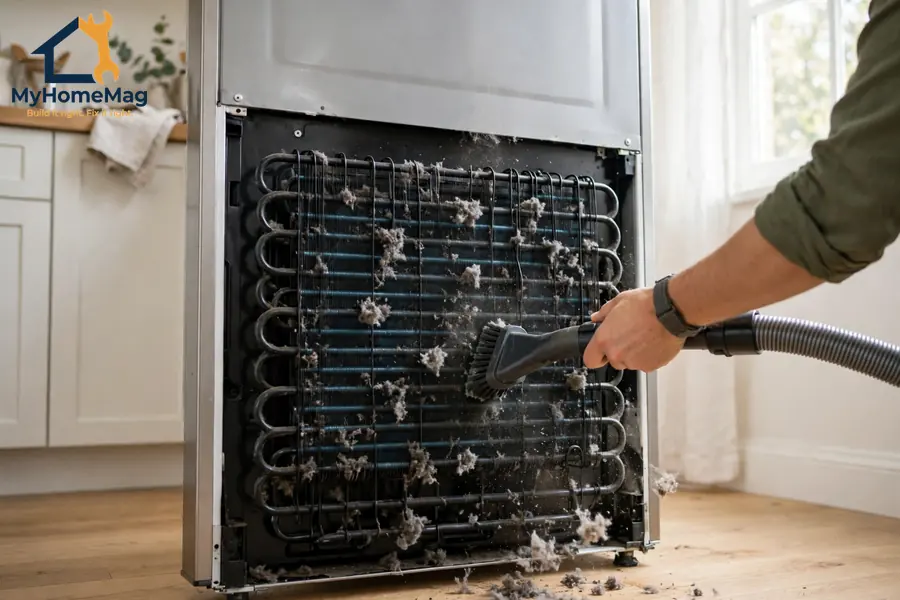
Condenser coils release heat into the room. Coated in dust and pet hair, they cannot shed heat, so the compressor runs hotter, works harder, and eventually cuts out on its thermal protector. The smaller freezer copes longer, so the fridge warms first — exactly the pattern in this guide.
The coils sit underneath the fridge, behind a front grille, or on the back. Unplug the fridge first, then vacuum them gently with a brush attachment. While you are there, look for the condenser fan near the compressor: it should spin freely and run whenever the compressor runs.
Clean the coils twice a year; homes with pets may need it sooner. After cleaning, plug the fridge back in and give it four hours. If the compressor now runs in long, steady stretches and the temperature falls, dirty coils were the cause. If it still short-cycles within an hour, keep going — cleaning alone rarely fixes a failing relay.
Check 5: Frost Pattern — the Sealed-System Clue
The frost pattern on the evaporator coils tells a technician whether the sealed system is healthy, and you can read the broad version of it safely. Look at the back wall inside the freezer: a thin, even layer of frost across the whole panel is normal.
A partial pattern — frost on only part of the panel, or a small ball of ice in one corner while the rest is bare — points to a sealed-system problem, such as low refrigerant or a failing compressor. That is not a do-it-yourself repair. For the frost side of the problem — heavy, even frost and what causes it — see our guide on why a freezer frosts up. Do not add refrigerant, do not cut any line, and do not chip ice off the coils with a knife: a puncture can release refrigerant.
If you see a partial frost pattern, note it, take a photo for the technician, and call a professional. Sealed-system repairs often cost roughly $500 to $1,000 or more in the US, and on a fridge over ten years old they are often not worth doing.
Check 6: Power Supply and Voltage
A fridge that loses power briefly, or runs on a weak circuit, can behave exactly like a failing compressor. After a power outage, the compressor may need several minutes before it restarts; repeated restarts during flickering power can trip the overload protector.
Check that the fridge is plugged directly into a wall outlet, not an extension lead or a power strip. Check the circuit breaker, and confirm nothing else heavy — a microwave, a space heater — shares the circuit. If the lights dim when the fridge tries to start, the circuit may be overloaded, and an electrician should look at it before you blame the fridge.
If the problem started right after a storm or an outage, unplug the fridge for ten minutes, then plug it back in and listen for a normal, long compressor run. If it clicks and fails again, go back to Check 2.
What Repairs Cost, and When Replacement Makes More Sense
Treat every figure as an approximate US planning range, not a quote, and get a written estimate before authorising work.
| Repair | Approximate US range (installed) |
|---|---|
| Start relay or overload protector | $150–$300 |
| Thermostat replacement | $150–$300 |
| Condenser fan motor | $150–$350 |
| Condenser coil cleaning (professional) | $75–$150 |
| Electronic control board | $300–$600 |
| Compressor replacement | $600–$1,200+ |
| Sealed-system repair (refrigerant leak, evaporator) | $500–$1,000+ |
If a repair costs more than half a comparable new fridge and the unit is over ten years old, price a replacement. The US Department of Energy notes older refrigerators can use far more energy than modern ones.
A relay, thermostat, or fan repair on a fridge under eight years old is usually worth doing. A compressor or sealed-system repair on an old fridge usually is not.
Preventing the Next Warm Fridge
Most compressor-side causes build up slowly. Clean the condenser coils twice a year, keep at least a few inches of space behind and above the fridge so heat can escape, and check the temperature monthly with a thermometer. A fridge that starts clicking, short-cycling, or running in bursts is warning you weeks before the food warms up. Do not ignore it.
When to Call a Professional
Call a professional if the compressor clicks and fails to start, the frost pattern is partial, the fridge warms again within days of a fix, or the compressor is very hot and cuts out repeatedly.
Call sooner if you smell burning, hear loud clicking, or see damaged wiring. Sealed-system work — refrigerant, compressor replacement, or a suspected leak — needs licensed handling and is not a do-it-yourself job.
Before the visit, note your thermometer readings, whether the compressor vibrates, how long it runs before clicking off, and what the frost pattern looks like. That short list saves the technician an hour of guessing.
A Simple Plan to Follow
Start with food safety, then work in order: feel for the compressor, listen for the clicking, test the thermostat, clean the coils, read the frost pattern, and check the power. Stop at the first check that explains the problem.
If one check fixes it, give the fridge four hours to settle. Do not ignore short-cycling: a relay that fails today becomes a dead compressor next month, and a warm fridge is the first warning, not the last.
Frequently Asked Questions
Why is my fridge not cold but the freezer is?
The freezer is smaller and better insulated, and it gets the cold air first, so it holds its temperature longer when cooling capacity drops. A struggling compressor, a failed start relay, or dirty condenser coils all reduce capacity, and the fridge — the larger compartment — warms first.
How do I know if my compressor is running?
Put your hand on the lower back of the fridge while it is plugged in. A running compressor gives a steady, low vibration and a deep hum. Fans make a lighter whir. If you feel nothing while the fridge is warm, the compressor is not running.
Why does my fridge click every few minutes?
That is usually the start relay failing, or the overload protector cutting power after a failed start. The compressor tries to start, cannot, and clicks off. Let it cool for an hour, try once more, and if it still clicks and fails, call a technician. Do not keep forcing restarts.
Can dirty condenser coils make the fridge warm?
Yes. Dusty coils cannot shed heat, so the compressor runs hotter and cuts out on its thermal protector. The freezer copes longer, so the fridge warms first. Cleaning the coils is free and worth doing before anything else.
Is it worth replacing a compressor?
A compressor replacement often costs roughly $600 to $1,200 or more installed. On a fridge under eight years old it can be worth it; on a fridge over ten years old, or when a sealed-system repair is also needed, pricing a new fridge usually makes more sense.
When should I call a professional instead of checking myself?
Call a professional if the compressor clicks and fails, the frost pattern is partial, or the fridge warms again within days. Call sooner for burning smells, sparking, or damaged wiring. Never open the sealed refrigerant system yourself.
Related Guides
- MyHomeMag
- Appliance Guides
- Fridge Not Cooling but Freezer Works? Causes and Safe Checks
- Refrigerator Leaking Water Inside? Causes and Safe Fixes
- Ice Maker Stopped Making Ice? Causes, Checks, and Safe Fixes
- Freezer Frosting Up? Causes, Defrost Steps, and Prevention
- Water Stuck in Washing Machine? Why It Won’t Spin and What to Check
- Washing Machine Not Draining? Filter, Pump, and Hose Checks
- Dryer Not Heating? Electric and Gas Checks to Try First
- Dryer Takes Too Long to Dry? Vent and Airflow Fixes to Try
- Washing Machine Shaking Violently? Level It and Stop the Banging

5 Responses