
You open the freezer for a bag of vegetables and find the walls coated in white ice, the drawers stuck, and the food buried under frost. A freezer frosting up is one of the most common refrigerator complaints, and it rarely fixes itself.
The good news is that frost always has a cause. Somewhere, warm, humid air is getting in, or the system that melts frost away has stopped working. Find which one it is, and the fix is usually simple.
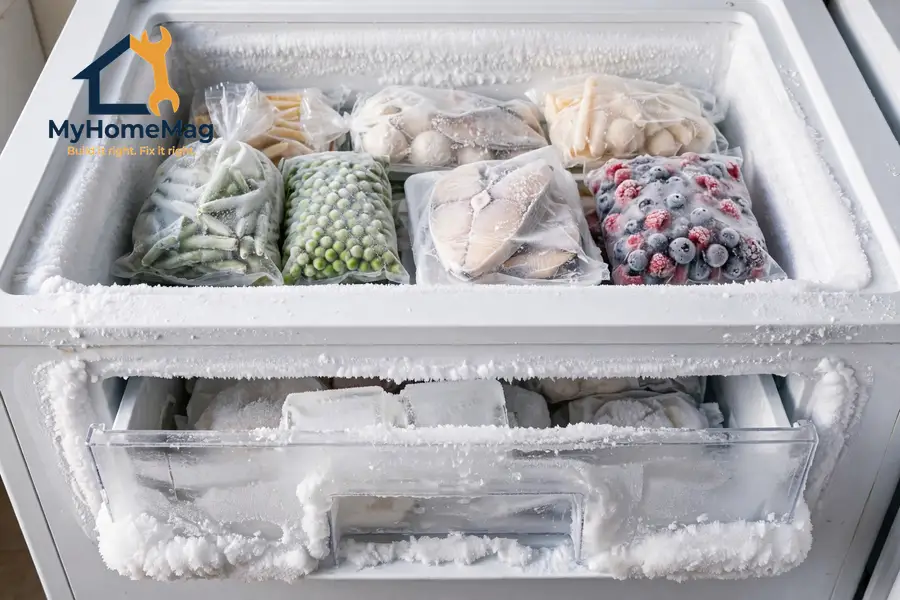
How Frost Forms in a Freezer
Frost is frozen water vapour. Every time the freezer door opens, warm, humid air from the room flows in. When that air hits the cold walls and coils, the moisture freezes onto them as a thin layer of frost. A little is normal, even in a frost-free model between defrost cycles — but when the layer keeps growing, it insulates the coils, blocks airflow, and forces the compressor to run longer. So freezer frost build up is a symptom, not the disease: the real question is why moisture keeps arriving, or why the defrost system is not clearing it.
Common Causes at a Glance
| Cause | What you may notice | First safe check |
|---|---|---|
| Door left ajar or not closing fully | Frost near the door edges, drawers sticking | Check the door closes and latches |
| Worn or dirty door gasket | Frost in freezer around the seal, condensation | Paper test on the door seal |
| Defrost system failure | Thick, even frost over the whole back wall | Note the pattern, then call a pro |
| Warm or humid air entering often | Frost after hot weather or a big shop | Check door habits and room humidity |
| Blocked vents or overstuffed shelves | Frost in one corner, poor cooling | Clear the vents and leave gaps |
| Clogged defrost drain | Water pooling under drawers, ice on the floor | Look for ice at the drain opening |
| Faulty temperature setting | Freezer too cold, frost forming fast | Check the control is at 0°F |
| Damaged door or misaligned hinges | Frost along one side only | Look for gaps or a door that sags |
This table is a starting point, not a diagnosis. Work through the checks in order.
Safety First: Before You Touch Anything
A freezer is safe to check, but defrosting involves water, electricity, and sharp ice. Use this short checklist before any check in this guide:
- Unplug the freezer before removing any panel, cover, or the back wall inside the freezer; the fan can start without warning.
- Move frozen food into coolers with ice, or into a neighbour’s freezer, before a full defrost.
- Never chip ice with a knife or screwdriver: one slip can puncture a refrigerant line or a cooling coil.
- Keep towels on the floor and a shallow tray ready — a full defrost produces litres of meltwater.
- Do not use a hair dryer on its hottest setting close to plastic parts, and never pour boiling water directly onto the coils.
- If you smell burning, see sparking, or find damaged wiring, stop and unplug the unit.
Check 1: Is the Door Closing Properly?
A door that does not close fully is the most common cause of frost in freezer complaints, and the easiest to fix.
Look for the obvious first: a drawer that sticks out, a food package wedged at the back, or an ice tray blocking the door. Push every drawer fully home, then close the door and watch it latch. Also check for sagging: if one side sits lower than the other, the hinges may be loose or worn, and even a small gap lets warm air pour in all day.
Check 2: The Door Gasket
The door gasket is the rubber seal around the freezer door. When it is worn, torn, or hardened, warm air leaks in constantly, and frost builds up fastest near the seal.
Try the paper test: close the door on a sheet of paper and pull gently. You should feel resistance all the way around. If the paper slides out easily in one spot, the seal is weak there.
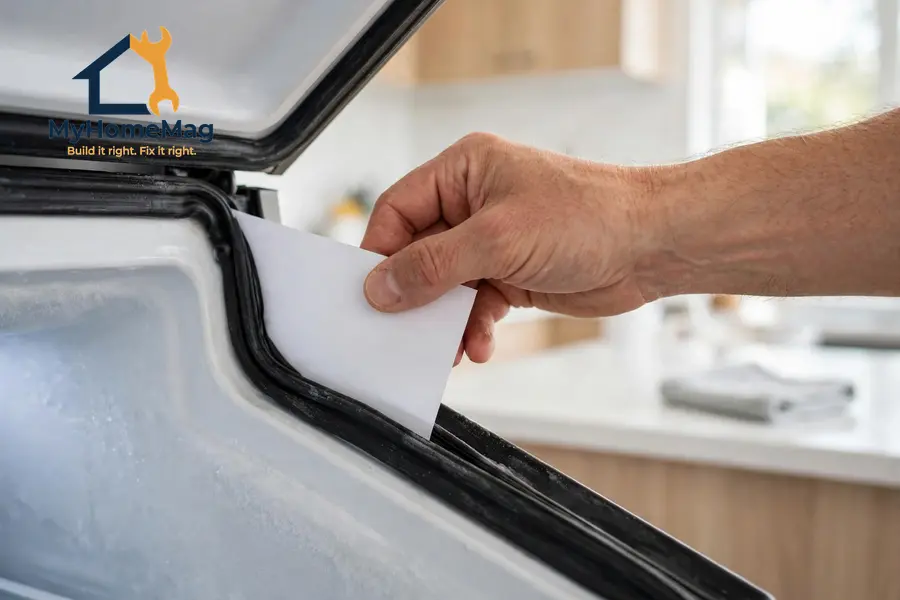
Wipe the gasket with warm soapy water and look for tears, cracks, or sections gone flat and hard: a gasket that no longer springs back needs replacing. A new freezer door gasket often falls in an approximate range of $100 to $250 installed in the US, depending on the model. If the paper test shows the seal is weak, our guide to refrigerator door gasket replacement walks through measuring, fitting, and testing a new one.
Frost that concentrates around the door edges points to the seal, while frost spread evenly over the whole back wall points to the defrost system — useful when frost keeps returning after a full defrost.
Check 3: The Defrost System
Most modern freezers are frost-free: a heater melts frost off the evaporator coils on a timer, and the water drains away. When any part of that system fails, frost builds up until it chokes the coils.
The defrost system has three main parts: a heater, a thermostat, and a timer or control board. If the heater burns out, nothing melts the frost; if the thermostat fails, the heater never switches on; if the timer sticks, the cycle never runs.
The clue is the pattern. Thick, even frost covering the whole back wall, building up over weeks, points to the defrost system. So does a freezer that works well for a week after a manual defrost, then frosts over again.
A manual defrost clears the symptom for a few days, but it will not fix the cause. If frost returns quickly after a full defrost, call a technician — a defrost repair often costs roughly $150 to $350 installed.
Check 4: Warm Air and Humidity
Sometimes the freezer is fine and the room is the problem: in a hot, humid summer every door opening brings in far more moisture than in winter, and a garage freezer faces wide temperature swings.
Shorten door openings in humid weather, and avoid putting hot food straight into the freezer: let it cool first, then pack it in sealed bags or containers. Open containers and unwrapped food release moisture directly into the freezer air. The US Environmental Protection Agency suggests keeping indoor humidity below 60 percent, and ideally between 30 and 50 percent.
Check 5: Blocked Vents and Overstuffed Shelves
Cold air must circulate inside the freezer. When vents are blocked by boxes, or shelves are packed solid, cold air pools in one spot and frost builds up there.
Find the vents on the back wall and clear them, leaving a gap of a few inches in front of each. A freezer packed after a big shop can take a full day to settle, and frost forms while the compressor runs constantly to catch up. Keep the freezer reasonably full — a full freezer holds its temperature better — but leave space for air to move between items. Heavy frost can also jam the ice maker, so if yours has stopped producing ice as well, see our guide to an ice maker that stopped making ice.
Check 6: The Defrost Drain
When the defrost heater melts frost, the water runs down a drain at the back of the freezer, through a tube, into a pan underneath. If that drain clogs, water pools under the drawers and refreezes as a sheet of ice on the freezer floor.
Look for water under the bottom drawer, or a layer of ice on the freezer floor. That is the signature of a clogged drain, not a failed defrost heater. The same drain can also send water into the fresh-food section — if you are seeing that instead, see our guide to a refrigerator leaking water inside.
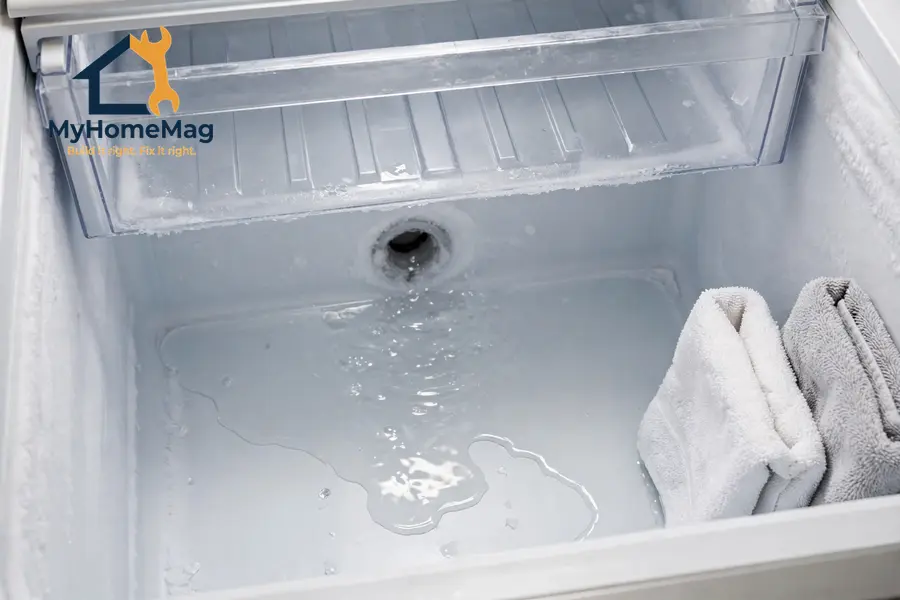
You can clear it safely: unplug the freezer, remove the bottom drawer, and flush the small drain opening at the back gently with warm water using a turkey baster. Do not force a wire down the tube, and do not pour boiling water into it. If the water still will not drain, a full defrost followed by another flush usually clears it; if it does not, call a technician.
Check 7: Temperature Settings
A freezer set far below 0°F does not keep food safer, but it does make frost form faster, because colder coils condense more moisture from every puff of room air.
The FDA recommends a freezer temperature of 0°F. Put a freezer thermometer on a middle shelf, close the door, and wait at least four hours. If the reading is far below 0°F, turn the control up a notch and re-check after a day. If the temperature will not change at all, the thermostat or control board may be faulty — a job for a technician.
How to Defrost Safely, Step by Step
When frost is thick, a manual defrost is the fastest way back to a working freezer — a few hours done properly, and risky if rushed.
- Unplug the freezer and move all food into coolers with ice.
- Remove the drawers and shelves, and put towels on the floor in front of it.
- Leave the door open and let the ice melt naturally. A bowl of hot water placed inside speeds things up; replace it as it cools.
- Wipe up meltwater as it appears, so it does not run onto the floor.
- Once all the ice is gone, wipe the inside dry, including the drain opening.
- Plug the freezer back in, wait until it reaches 0°F — usually two to four hours — then reload.
Never use a knife, chisel, or screwdriver to chip ice off: a punctured refrigerant line can release gas, and a damaged coil can mean replacing the whole freezer.
What Repairs Cost, and When Replacement Makes More Sense
Treat every figure as an approximate US planning range, not a quote, and get a written estimate before authorising work.
| Repair | Approximate US range (installed) |
|---|---|
| Door gasket replacement | $100–$250 |
| Defrost heater or thermostat | $150–$350 |
| Defrost timer or control board | $150–$400 |
| Defrost drain clearing (professional) | $75–$150 |
| Door hinge or alignment repair | $100–$250 |
| Sealed system repair (compressor, refrigerant leak) | $500–$1,000+ |
If a repair costs more than half a comparable new freezer and the unit is over ten years old, price a replacement — the US Department of Energy notes older freezers can use far more energy than modern ones. A gasket, defrost, or drain repair on a freezer under eight years old is usually worth doing.
Preventing Frost From Coming Back
Most frost problems build up slowly, so a few habits keep them away. Check the door seal every few months with the paper test, keep the vents clear after every big shop, and pack food in sealed bags rather than open boxes. Let hot food cool before freezing it, keep door openings short in humid weather, and clean the condenser coils twice a year. A defrost cycle makes a faint hiss or drip as ice melts — silence for weeks followed by thick frost is an early warning that the defrost system has stopped.
When to Call a Professional
Call a professional if frost returns quickly after a full defrost, if the back wall is covered in thick, even frost, or if the temperature will not hold at 0°F — sooner still if you smell burning, hear loud clicking, or see damaged wiring. Sealed-system work needs licensed handling and is not a do-it-yourself job.
Before the visit, note how fast the frost returns, whether it concentrates near the door or covers the whole back wall, and whether the drain is clear. If the fresh-food section is warm too, the fault may be the evaporator fan or the damper — a different path, covered in our companion guide where a fridge not cooling but freezer works is the starting point.
A Simple Plan to Follow
Start with the door, then the gasket, then the frost pattern: frost near the edges means warm air is getting in, while even frost over the whole back wall that returns after defrosting means the defrost system has failed. Defrost fully and safely, fix the cause, and give the freezer four hours to settle at 0°F before reloading.
Frequently Asked Questions
Why is my freezer frosting up all of a sudden?
A sudden frost build up usually means warm air has started getting in: a door left ajar, a drawer blocking the door, or a gasket that has just torn. Check the door and the seal first. If both are fine, the defrost system may have failed.
How do I stop frost building up in my freezer?
Keep the door closed properly, test the gasket with the paper test, pack food in sealed bags, and let hot food cool before freezing it. If frost keeps returning after a full defrost, the defrost system or the door seal needs repair — no habit fixes a failed part.
Is it safe to chip ice off the freezer with a knife?
No. Never chip ice with a knife, screwdriver, or any sharp tool. One slip can puncture a refrigerant line or a cooling coil, turning a simple defrost into a costly repair. Let the ice melt naturally, or speed it up with a bowl of hot water inside the freezer.
How often should a frost-free freezer defrost itself?
A frost-free freezer runs a defrost cycle roughly every 8 to 12 hours, melting a thin layer of frost off the coils each time. You should rarely see more than a light dusting. Thick frost that lasts for weeks means the cycle is not running.
Can a bad door seal cause frost in the freezer?
Yes, it is one of the most common causes. A worn or torn gasket lets warm, humid air leak in constantly, and frost builds up fastest near the seal. The paper test shows where the seal is weak, and a replacement often costs roughly $100 to $250 installed.
Why is there water pooling under my freezer drawers?
Water under the drawers usually means the defrost drain is clogged. Meltwater from the defrost cycle has nowhere to go, so it pools and refreezes. Flush the drain gently with warm water using a turkey baster.
Should I replace my freezer if it keeps frosting up?
Not usually. A gasket, defrost, or drain repair on a freezer under eight years old is often worth the approximate $100 to $400 cost. Consider a replacement only if the repair costs more than half a comparable new unit, the freezer is over ten years old, or the fault is in the sealed system.
Related Guides
- MyHomeMag
- Appliance Guides
- Fridge Not Cooling but Freezer Works? Causes and Safe Checks
- Refrigerator Leaking Water Inside? Causes and Safe Fixes
- Refrigerator Door Gasket Replacement: Fit, Cost, and Testing
- Ice Maker Stopped Making Ice? Causes, Checks, and Safe Fixes
- Fridge Not Cold but Freezer Is? Checks to Try Before a Pro
- Water Stuck in Washing Machine? Why It Won’t Spin and What to Check
- Washing Machine Not Draining? Filter, Pump, and Hose Checks
- Dryer Not Heating? Electric and Gas Checks to Try First
- Dryer Takes Too Long to Dry? Vent and Airflow Fixes to Try
- Washing Machine Shaking Violently? Level It and Stop the Banging
5 Responses