
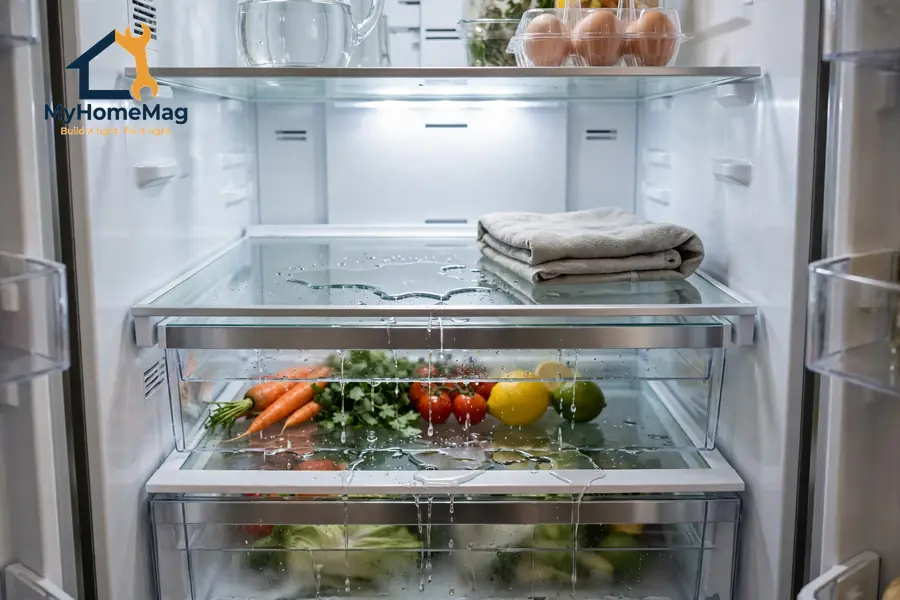
You open the fridge and find a puddle on a shelf, or water pooling under the crisper drawers. It can turn serious fast: standing water warps shelves and encourages mold.
Most indoor fridge leaks come from a short list of causes, and the fridge is often still cooling fine — usually a clogged defrost drain, a filter not seated properly, or an ice maker line worked loose.
Where the Water Comes From
Warm, humid air enters every time you open the door, condenses on the cold walls and coils, and runs down to a drain — so a refrigerator makes water all the time, even when nothing is broken.
In a healthy fridge, it melts during defrost, drains through a small hole at the back, and flows down a tube into a pan underneath, where it evaporates. If that path is blocked, the water pools on shelves instead.
First Steps When You Find Water Inside
First, protect your food: move anything sitting in water into a clean container, and throw out packaging that has soaked through.
Second, check the temperature: the FDA recommends 40°F or below for the refrigerator, and 0°F for the freezer.
Third, note where the water is: under the crispers points to the defrost drain, near the top points to the filter, and at the back wall points to the drain or ice maker line.
Common Causes at a Glance
| Cause | Where the water appears | First safe check |
| Clogged defrost drain | Under the crispers | Find the drain hole |
| Frozen drain tube | Puddle returns | Look for ice at the drain |
| Water filter not seated | Near the filter | Reseat the filter |
| Ice maker line loose | Back wall | Inspect the line |
| Worn door gasket | Condensation on walls | Paper test the seal |
| Drain tube disconnected | Water under the fridge too | Look behind the unit |
| Door left open | Condensation everywhere | Check door closure |
Use this table to pick your starting point, then work through the checks below in order.
Safety First: Before You Touch Anything
Water and electricity are a bad combination, so take this seriously even though a fridge leak looks harmless.
- If water has reached the floor, the power cord, or the outlet, do not step in it. Unplug the fridge from a dry position, or switch it off at the breaker.
- Unplug the fridge before removing any panel or cover — fans and heaters can start without warning.
- Find the water shut-off valve first — usually behind the fridge, under the sink, or in the basement below.
- Wear gloves, and keep towels and a bucket ready.
- Never chip ice with a knife or screwdriver.
- If you smell burning, see sparking, or find damaged wiring, stop and call a professional.
Check 1: Find Exactly Where the Water Is
Dry the inside completely, then watch where the water comes back — the fastest way to find the source.
Wipe every shelf dry, close the door, and wait an hour. Then look: is the water back under the crispers, at the back wall, or near the filter?
Water under the crispers points to a clogged defrost drain (Check 2); water dripping from the top points to the filter or ice maker (Checks 3 and 4). If the floor is wet too, the drain tube may have come loose (Check 6).
Check 2: The Clogged Defrost Drain
This is the most common cause of a refrigerator leaking water inside, so check it first.
The defrost drain is a small hole at the back of the freezer or fresh-food section, sometimes behind a plastic cover. Meltwater should run through it to a pan underneath, but crumbs and slime build up over time, and once it blocks, water backs up onto the shelves.
Unplug the fridge, remove the crisper drawers, and find the drain hole — usually in a shallow trough at the back, just above the bottom shelf. If you cannot see it, check your owner’s manual.
Pour a cup of warm water, not boiling, into the hole. If it drains away, the blockage was partial. If it sits there, use a turkey baster to push warm water through. Never force a wire or screwdriver down the drain: you can puncture the tube.
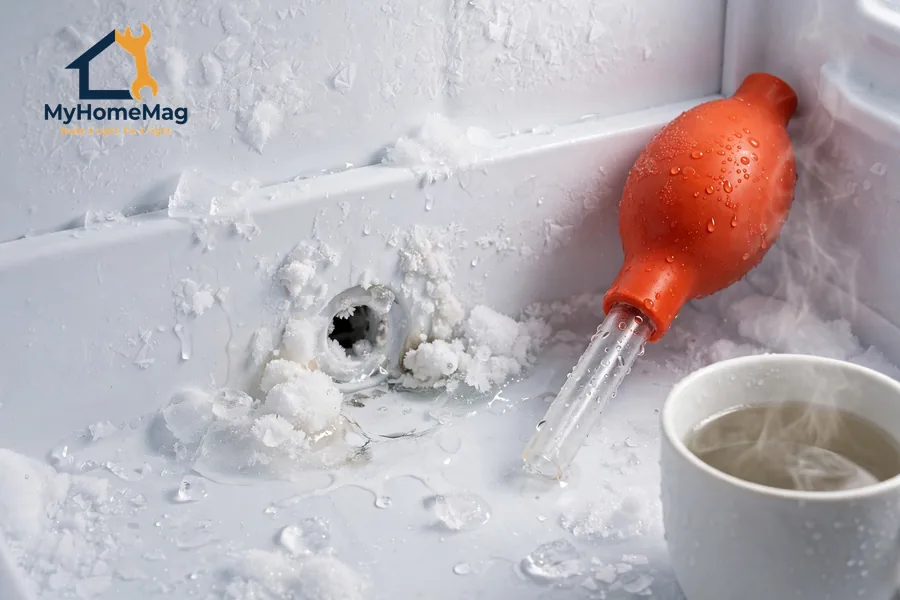
If the Drain Tube Is Frozen
A frozen drain tube looks like a clogged one, but warm water poured into the drain will not go through at all, and you may see ice around the opening.
The fix is a full manual defrost: unplug the fridge, move perishables into coolers with ice, and leave the doors open until all the ice melts. Do not use a hair dryer on high or a heat gun. If the drain freezes again within a few weeks, the defrost heater or thermostat may be failing — a job for a technician.
Check 3: The Water Filter and Its Housing
If the water is near the top of the fresh-food section, or dripping from around the filter, the filter is the next suspect.
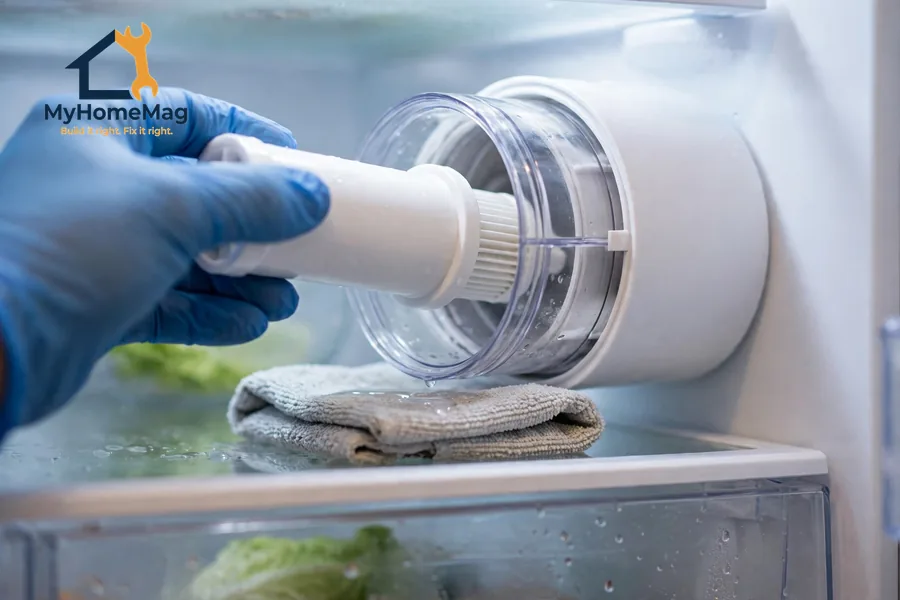
Most modern refrigerators have a replaceable water filter inside the fresh-food section, often at the top right, or in the base grille. It sits under water pressure whenever the supply is on, so a filter that is not fully seated leaks slowly — a few drops an hour is enough to form a puddle overnight. A cracked housing or damaged O-ring does the same.
Remove the filter and check the housing for cracks and the seal for nicks. Reinstall it firmly, turning until it clicks or locks, then run the dispenser for a few seconds and watch for drips. If it still leaks with a new, correctly fitted filter, the housing may be cracked — a replacement often costs roughly $100 to $250 installed.
Do not run the fridge with the filter removed and no bypass plug fitted: water can spray from the empty housing.
Check 4: The Ice Maker Supply Line
The ice maker gets its water through a thin supply line from the household connection to the back of the fridge, then up to the ice maker. It can leak at the shut-off valve, at the back connection, or inside the freezer.
Shut off the water, put towels behind the unit, and pull the fridge out carefully.
A plastic line that is kinked, brittle, or yellowed with age is a leak waiting to happen, as is a braided stainless line corroded at the fittings. Tighten a loose fitting gently — do not overtighten, since a cracked fitting leaks worse.
Inside the freezer, look at the fill tube that drops water into the ice mold. If it is iced over, the fill valve may be letting water through slowly — a technician can test it, since it is an electrical part. Replace a damaged line rather than patching it.
Check 5: The Door Gasket and Condensation
Sometimes a fridge leaking inside has no leak at all: the water is condensation from a worn door gasket letting warm, humid air in around the clock.
You will notice this in summer or a humid kitchen: moisture on walls and shelves, droplets on packaging, and a fridge that runs almost constantly.
Try the paper test: close the door on a sheet of paper and pull. Resistance all the way around is normal; if it slides out easily in one spot, the gasket is weak there. Wipe it with warm, soapy water and look for tears or sections gone flat and hard — a gasket that no longer springs back needs replacing, often roughly $100 to $250 installed.
Check 6: The Drain Tube and Drain Pan
If water is inside the fridge and on the floor, the drain tube may have come loose from the pan underneath.
The drain pan sits under the fridge, near the compressor, and catches water from the defrost drain. Heat from the compressor evaporates it — but if the tube feeding it has slipped off, the water lands on the floor instead.
Unplug the fridge, pull it out, and look underneath for the shallow pan and the tube from the cabinet. If the tube is disconnected, push it back on so it points into the pan, and check the pan for cracks — a cracked pan leaks every time the fridge defrosts. While you are there, check the supply line for drips at the valve and the back connection.
Check 7: Temperature, Humidity, and Habits
A fridge that is too warm, or a door opened constantly, can produce water even when every part works. Warm air holds more moisture, and every opening lets a fresh load in. Set the fridge to around 37°F and the freezer to 0°F.
Overstuffing makes it worse: food packed against the back wall blocks the drain trough and vents, so condensation pools. Leave a gap of a few inches behind food.
Hot food does the same: let it cool first, then cover it before refrigerating.
What Repairs Cost, and When Replacement Makes More Sense
Treat every figure as an approximate US planning range, not a quote, and get a written estimate before authorising work.
| Repair | Approximate US range (installed) |
| Defrost drain clearing | $100–$200 |
| Filter housing replacement | $100–$250 |
| Supply line replacement | $100–$200 |
| Fill valve replacement | $150–$300 |
| Door gasket | $100–$250 |
| Defrost heater or thermostat | $150–$350 |
| Drain pan replacement | $75–$150 |
Most indoor fridge leaks are cheap to fix, and a professional visit is usually a one-hour job. Replacement only makes sense when the leak comes with other problems: the fridge is over fifteen years old, it is also not cooling, or the repair costs more than half of a comparable new fridge. Older refrigerators can also use far more energy than modern ones, the US Department of Energy notes.
Preventing the Next Puddle
Clean the defrost drain once a year with warm water. Change the filter every six months and check the housing for drips. Check the gasket twice a year with the paper test, keep food away from the back wall, and look behind the fridge once a year.
When to Call a Professional
Call a professional if the drain keeps clogging or freezing after a full defrost, the housing is cracked, the fill valve is suspect, or you cannot shut off a damaged water line.
Call sooner if water has reached the power cord, outlet, or floor, or if you smell burning or see damaged wiring. Before the visit, note where the water appears and what you have tried.
If the fridge is also warm, the problem may be bigger than a leak: a fridge not cooling but freezer works pattern points to airflow or a fan fault instead.
A Simple Plan to Follow
Dry the inside, note where the water returns, and work in order: defrost drain, filter, ice maker line, gasket, drain tube, then temperature and habits. Stop at the first check that explains the puddle.
If one fix works, give the fridge a few hours and check again. A fridge leaking inside is usually a small, fixable problem — but a puddle that keeps coming back deserves attention before it reaches the floor.
Frequently Asked Questions
Why is there water under the crisper drawers in my fridge?
A clogged defrost drain is the most common cause. Meltwater cannot drain away, so it backs up and pools at the bottom of the fresh-food section. Clearing the drain with warm water usually fixes it.
How do I unclog a refrigerator defrost drain?
Unplug the fridge and pour warm water through the drain hole at the back wall. A turkey baster can push water through a stubborn blockage.
Can a bad water filter cause a refrigerator leaking water inside?
Yes. A filter that is not fully seated, or a cracked housing, leaks slowly under pressure. Reseat the filter firmly, and replace the housing if it is cracked.
Why is my fridge leaking water inside but still cold?
The cooling and drainage systems are separate. If the fridge is still cold, the water is coming from a blocked drain, a filter, or an ice maker line — not a failed compressor.
Is water inside the fridge dangerous?
A small puddle is mostly a nuisance, but standing water can spoil food and encourage mold. Water near the power cord, outlet, or floor is a safety risk: unplug the fridge from a dry position and call a professional.
How much does it cost to fix a refrigerator leaking water inside?
A clogged drain or loose filter often costs nothing to fix yourself. A professional drain clearing or supply line replacement usually falls in an approximate US range of $100 to $200, and a housing or valve replacement roughly $100 to $300 installed.
Related Guides
- MyHomeMag
- Appliance Guides
- Fridge Not Cooling but Freezer Works? Causes and Safe Checks
- Dishwasher Not Draining? Causes, Fixes, and When to Call a Pro
- Bosch Dishwasher Not Draining? Causes, Safe Checks, and When to Call a Pro
- Washing Machine Leaking: Find the Source, Stop the Water, and Fix It Safely

One Response