
A puddle at the front of the dishwasher is hard to ignore, and it is also easy to misread. Water on the kitchen floor does not always mean the same part has failed. Sometimes the water has run down the front of the door from a worn door gasket. Sometimes it has come from a hose underneath the machine and spread forward along the floor. Finding out which one it is matters, because a gasket is a simple seal you can see and touch, while a hose leak is hidden and can keep dripping even when the dishwasher is off.
Before anything else, it helps to be clear about what this guide covers. Our companion article on dishwasher not cleaning dishes is about a cleaning fault: the cycle finishes, the water drains away, and the dishes still come out dirty. This article is about a different fault — a dishwasher leaking from the bottom, with water escaping onto the floor. If your dishes are dirty but the floor is dry, that is the cleaning article. If the floor is wet, start here. A leak comes first, because water on the floor can damage cabinets and flooring and can be a slip and electrical hazard.
The short answer is that bottom leaks often come down to two common suspects. The first is the door gasket, the rubber seal around the door that keeps water inside the tub during the wash. The second is a hose — the water inlet hose that brings water in, or the drain hose that carries it out. This guide shows how to tell them apart, what to check safely in each case, what a repair usually costs in approximate US planning ranges, and when to stop and call a professional.
A dishwasher leaking from the bottom is most often caused by a worn or dirty door gasket, or by a loose, cracked, or split hose underneath or behind the machine. Dry the floor, then run a short supervised rinse cycle and watch where the water first appears: at the bottom of the door, or from under the machine. If water appears, stop the cycle, shut off the power and water, and mop up the water before you touch anything underneath.
Where Is the Water Coming From?
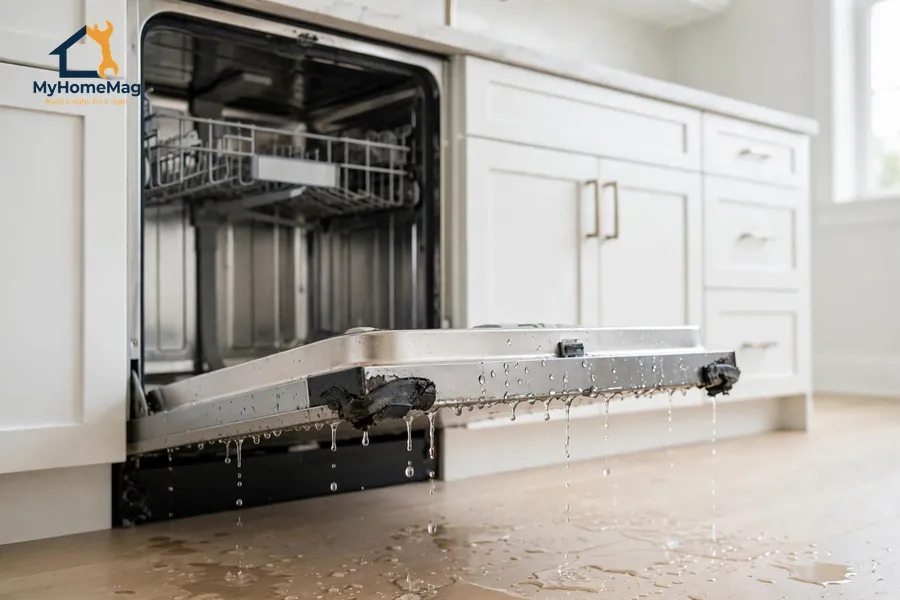
The first job is not to fix anything. It is to find out where the water starts. A leak at the bottom of a dishwasher can travel: water from a door gasket runs down the front of the door, while water from a hose underneath can run forward along the floor and appear in the same place. The puddle itself tells you very little. Where the water first appears tells you much more.
Start by mopping up the water and drying the floor and the front of the dishwasher completely. Then lay a few dry paper towels along the bottom edge of the door and a few more on the floor under the front of the machine, where you can see them. Run a short rinse cycle and watch. Do not leave the room. If the towels at the door edge get wet first, or you can see water beading along the bottom of the door, the leak is most likely at the door. If the towels on the floor get wet first, or water appears from under the machine while the door edge stays dry, the leak is most likely underneath, which points to a hose or a fitting.
Timing helps too. A leak early in the cycle, as the tub fills, often points to the inlet side. A leak during washing or draining more often points to the door gasket or the drain hose. A leak that keeps dripping when the machine has not run points to the water supply side, because the inlet hose is under household water supply pressure even when the machine is off — and that leak will not stop on its own.
One more quick check: open the door after a cycle and look at the bottom edge of the tub, just inside the door. Water sitting there points to the door seal; a dry door with a wet floor under the machine points underneath instead.
Door Gasket Problems: A Common Door Leak
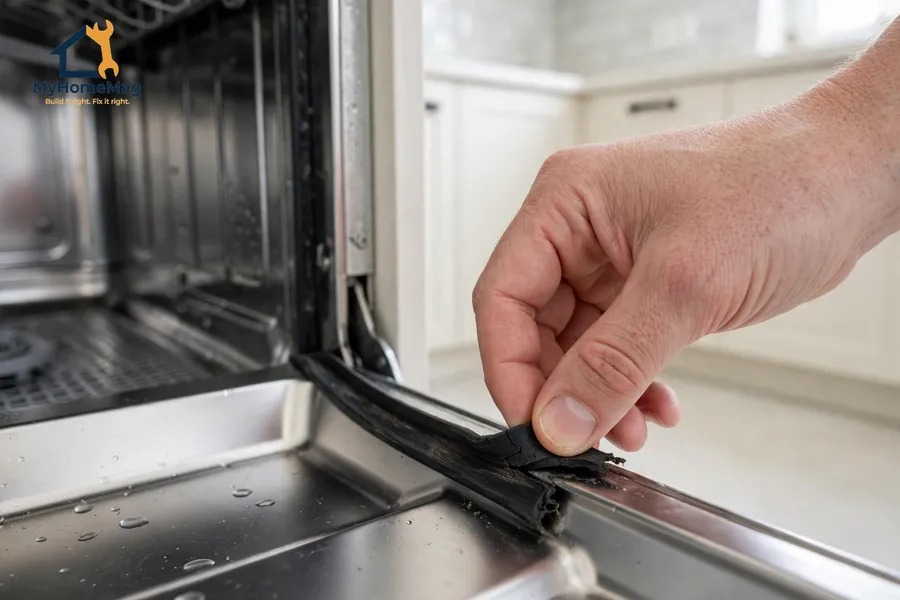
The door gasket is a rubber seal that runs around the inside edge of the dishwasher door or the front of the tub, depending on the model. When the door closes, the gasket is squeezed against the tub and forms a watertight seal. It is a simple part, but it works hard: it is pressed, heated, soaked in detergent, and dried out again on every cycle. Over time, that wear shows.
A gasket usually fails in one of four ways. First, it can simply wear out and lose its spring. The rubber goes flat or hard, so it no longer presses tightly against the tub, and water finds a gap — usually at the bottom corners, where the seal has to turn a corner. Second, it can crack or split, often at those same corners. A small split is enough: water under pressure from the spray arms will find it. Third, it can come loose from its channel. A section that has slipped out leaves a gap that water runs straight through. Fourth, it can get dirty. Dried food, grease, and detergent buildup along the gasket stop it sealing flat, even when the rubber itself is still in good shape.
You can check all four without tools. With the power off, run a finger along the gasket and feel for cracks, hard or brittle sections, and places where the rubber feels flat instead of springy, especially at the bottom corners. Check that it sits evenly in its channel, and wipe it and the surface it presses against with a damp cloth. If the gasket is only dirty, cleaning it may be enough — wipe it down and run a short rinse cycle to see whether the leak has stopped. If the gasket is cracked, split, hard, or loose, cleaning will not fix it — it needs replacing. On many models the old gasket pulls out of its channel and the new one presses in, but if it is glued in, if the door has to come apart, or if you are unsure which part fits, that is a job for a professional. A gasket forced into the wrong channel will leak just as badly as the old one.
One more door problem is often mistaken for a gasket fault: the door itself not closing squarely. A dishwasher that has been pulled out and pushed back, or one with a loose hinge or a door that drops slightly when opened, may not press the gasket evenly. If the door feels loose, sags, or needs a push to latch, mention that to the repairer. A new gasket will not fix a door that does not close properly.
Hose Problems: Inlet Hose, Drain Hose, and Fittings
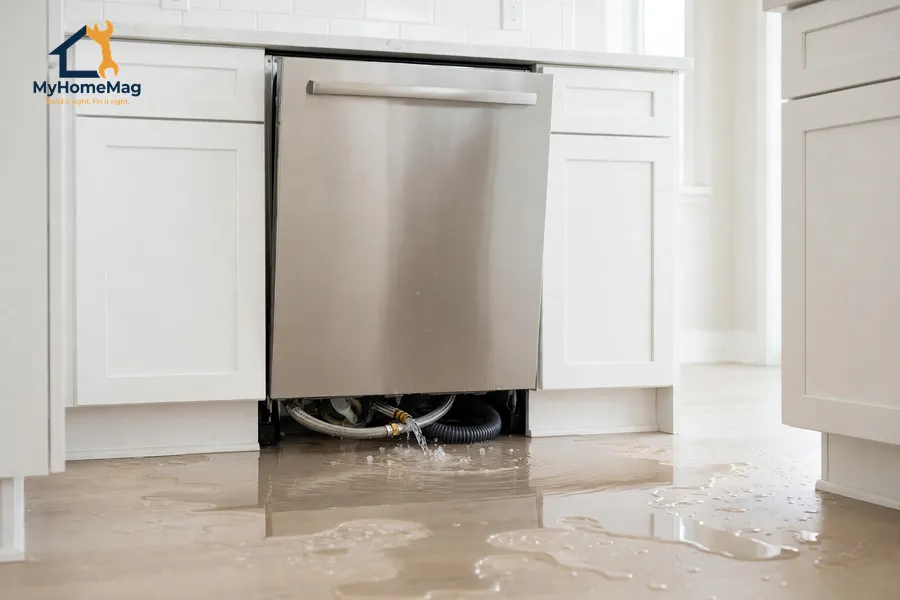
If the water is coming from under the machine rather than from the door, the hoses are the next place to look. A dishwasher usually has two: an inlet hose that brings clean water in from the household supply, and a drain hose that carries dirty water out to the sink drain or the garbage disposal. Both can leak, but they leak in different ways, and the difference helps you tell them apart.
The inlet hose is under household water supply pressure whenever the supply is turned on, even when the dishwasher is not running. That is why an inlet leak is the most urgent kind: it can drip all day, not just during a cycle. The usual causes are a loose connection, a worn washer inside that connection, or a hose that has cracked or split with age. A leak at a connection often shows as a slow drip, while a split hose can spray water under the machine. If the floor under the dishwasher is wet even though the machine has not run, turn off the water supply to the dishwasher first, then worry about the cause.
The drain hose only carries water when the machine pumps out, so a drain hose leak usually appears during the drain part of the cycle. The usual causes are a loose clamp where the hose joins the machine or the sink drain, a hose that has come off its connection, or a hose that has cracked, kinked, or been rubbed through where it passes a sharp edge.
Fittings matter as much as the hoses. A sound hose can still leak if its clamp is loose or the rubber washer inside the connection has perished, so a repairer will usually replace the clamp and washer with the hose.
Do not try to tighten a leaking hose connection while the water is still on, and do not reach under a machine that is running. Turn off the power and the water first, then look. Tightening a loose clamp may stop a small leak, but a cracked, split, or bulging hose needs replacing. If you cannot see the source without pulling the machine out, stop there — pulling a built-in dishwasher out can damage its water and drain connections and make the leak worse.
Other Leak Points Worth Checking
The door gasket and the hoses cover most bottom leaks, but not all of them. A short list of other suspects is worth working through before you settle on a diagnosis, because fixing the wrong part wastes time and money.
The first is overfilling. If the dishwasher fills with too much water, it can spill over the front of the tub even when the gasket is sound. The usual cause is a float switch that is stuck — the small float in the bottom of the tub that tells the machine when to stop filling. With the power off, lift the float gently and check that it moves freely. If it is stuck, clear whatever is jamming it; if the tub still overfills, the inlet valve may not be closing properly, and that is a professional repair.
The second is the wrong detergent, or too much of it. Dish soap instead of dishwasher detergent, or far too much detergent, creates excess suds that can push water out past the door seal. If the leak followed a change of detergent, run a rinse cycle with no detergent, clear the foam, and go back to the correct detergent in the right amount.
The third is a cracked tub or a leaking pump seal. These are less common, but they happen on older machines. A tub crack usually leaks from the same spot every time, and a pump seal leak often shows as a steady drip from the center of the machine. Neither is a simple home fix: both usually mean a part replacement, and on an older machine they are the point at which a repairer will talk about whether the repair is worth the cost.
Finally, check the simple things: a dishwasher that is not level can leak from the front, a large item pressing against the door can hold it open slightly, and a blocked spray arm can throw water straight at the seal. All three are quick to rule out.
How to Tell a Gasket Leak From a Hose Leak
When the floor is wet and the cause is not obvious, the table below is the quickest way to narrow it down. Match what you see to the pattern, then check that one part first.
| What you see | Most likely cause | First check |
| Water beading along the bottom of the door; door edge wet | Door gasket worn, cracked, loose, or dirty | Feel and look along the gasket, especially the bottom corners |
| Water appears during the wash, bottom edge of the door wet | Door gasket, or water thrown at the seal by a blocked spray arm | Gasket condition, then spray arm holes |
| Water under the machine, even when it has not run | Inlet hose or inlet connection leaking under household water supply pressure | Turn off the water supply, then check the inlet hose and fittings |
| Water appears during draining, or at the end of the cycle | Drain hose loose, cracked, or kinked | Drain hose clamps and the hose where it joins the sink drain |
| Water only after a detergent change, with lots of foam | Too much detergent or the wrong detergent | Run a rinse with no detergent; use the correct amount |
| Tub overfills and spills over the front | Float switch stuck, or inlet valve not closing | Float moves freely; if not, call a professional |
| Steady drip from the center underneath, every cycle | Pump seal or tub crack | Professional diagnosis — not a home fix |
The table is a guide, not a diagnosis. If two patterns fit, check the cheaper and easier one first — the gasket and the detergent — before assuming a hose or a pump has failed. If the pattern points to the inlet hose, act first and diagnose second: turn off the water supply, because that leak will not stop on its own.
What a Repair Usually Costs
Treat every figure in this guide as an approximate US planning range, not a quote, and get a written estimate before authorizing work. Prices vary by region, by model, and by how easy the part is to reach.
| Repair | Approximate planning range |
| Door gasket replacement, parts and labor | $120 to $250 |
| Door gasket part only, fitted yourself | $20 to $60 for the part |
| Inlet hose replacement, parts and labor | $120 to $250 |
| Drain hose replacement, parts and labor | $100 to $220 |
| Hose clamp or connection washer replacement | $80 to $150 as part of a visit |
| Float switch repair or replacement | $120 to $250 |
| Inlet valve replacement | $150 to $300 |
| Pump seal replacement | $200 to $400 |
| Diagnostic visit, if no repair is done on the same visit | $80 to $150 |
A gasket or a hose is usually a modest repair, and a leak left to keep dripping can damage flooring and cabinets. Ask for a written estimate that separates the part, the labor, and any call-out fee. If the repair is close to half the cost of a new dishwasher, ask the repairer for a straight answer about whether a replacement makes more sense.
Safety First: Before You Touch Anything
Water on the floor and an electrically powered appliance are a combination to treat with respect. Turn off the power before you work on the dishwasher — switch it off at the breaker, or unplug it only if the floor and your hands are dry — and turn off the water supply as well, especially if the leak is still dripping. Never reach into a running machine, and never reach underneath it while it is running or while the power is still on.
Water on the floor is a slip hazard and an electrical hazard. Mop it up before you step around the machine, keep your feet dry, and do not touch a plug or a socket with wet hands. If water has reached a socket or the wiring under the machine, do not touch it. Turn the power off at the breaker and call a professional.
Stop and call a professional if you cannot see where the leak is coming from without pulling the machine out, if the leak is from the inlet hose and you cannot turn the water off, if the machine trips the breaker, or if you can smell burning or see scorch marks. Stop as well if the floor, the cabinet, or the wall feels soft or swollen — that means water has been soaking in for longer than this one leak, and the damage needs assessing before the machine is used again. Gas rules do not apply to a dishwasher, but the power and water rules above always do.
Finally, do not keep running the dishwasher to test it while it is leaking. A short rinse cycle to find the leak, with you watching it, is a diagnostic check; full cycles will only put more water on the floor.
Your Quick Plan
If you find water at the bottom of the dishwasher, work through this order:
- Stop the cycle if one is running. Turn off the power — switch it off at the breaker, or unplug the machine only if the floor and your hands are dry — and turn off the water supply to the dishwasher.
- Mop up the water and dry the floor. Lay dry paper towels along the bottom edge of the door and on the floor under the front of the machine.
- Turn the power and water back on — but only after the floor is dry and you have checked for visible damage. Skip the test cycle if water is still flowing or the leak is heavy.
- Run a short rinse cycle and watch where the water first appears: at the bottom of the door, or from under the machine. Note when it appears — early, during washing, during draining, or after the cycle.
- If the door edge is wet, check the gasket: feel for cracks, hard or flat sections, and loose parts, especially at the bottom corners. Clean it if it is dirty; plan a replacement if it is cracked, split, or hard.
- If the water comes from underneath, check whether it is still dripping when the machine is off. If it is, the inlet hose or its connection is the suspect — keep the water off and call a professional if you cannot see the connection safely.
- Rule out the quick causes: the right detergent in the right amount, the float moving freely, the machine level, and the spray arms clear and not cracked.
- If the cause is a gasket or a hose and you can reach it safely with the power and water off, get a written estimate for the repair. If you cannot see the source, or the leak is from the pump or the tub, book a professional diagnosis rather than pulling the machine out yourself.
- After the repair, run one full cycle with you nearby and check the floor and the door edge afterwards. Do not leave a repaired dishwasher running unattended for the first cycle.
If the leak is heavy, if water is still flowing with the supply on, or if the floor or cabinets are already swollen or soft, keep the water off and call a professional the same day. A leak that will not stop is not a job to leave until the weekend.
Frequently Asked Questions
Why is my dishwasher leaking from the bottom?
A dishwasher leaking from the bottom most often has a worn, cracked, or dirty door gasket, or a loose, cracked, or split inlet or drain hose. Water from the gasket appears at the bottom of the door, while water from a hose appears from under the machine. Dry the floor, run a short rinse cycle, and watch where the water first appears to tell them apart.
Is a dishwasher leaking from the bottom of the door the same as a hose leak?
No. A dishwasher leaking from the bottom of the door usually means the door gasket is not sealing — it is worn, cracked, loose, or dirty, especially at the bottom corners. A hose leak comes from underneath or behind the machine, from the inlet hose or the drain hose and their connections. The fix is different for each, so finding the starting point matters before you order a part.
Can I still use my dishwasher if it is leaking onto the floor?
No — except for one short supervised rinse cycle to find the source of the leak. Do not run normal loads until the leak is found and fixed. Water leaking onto the floor can damage flooring and cabinets, and water on the floor is a slip and electrical hazard. Turn off the power and the water supply, mop up, and find the source first. Running full cycles on a leaking machine will only put more water on the floor.
How much does it cost to fix a dishwasher leaking from the bottom?
As approximate US planning ranges, a door gasket replacement usually costs $120 to $250 with parts and labor, an inlet hose replacement $120 to $250, and a drain hose replacement $100 to $220. A diagnostic visit alone is usually $80 to $150. Get a written estimate before authorizing work, as prices vary by model and region.
Can a dirty door gasket cause a leak?
Yes. Dried food, grease, and detergent buildup along the gasket can stop it sealing flat, even when the rubber is still in good shape. Wipe the gasket and the surface it presses against with a damp cloth and run a short rinse cycle to see whether the leak has stopped. If the gasket is cracked, split, hard, or loose, cleaning will not fix it and the gasket needs replacing.
When should I call a professional for a dishwasher leak?
Call a professional if the leak keeps dripping when the machine is off, if you cannot see the source without pulling the machine out, if the leak is from the pump or the tub, if the machine trips the breaker, or if the floor or cabinets feel soft or swollen. Also call one if the water supply cannot be turned off, or if you can smell burning. Those are not home fixes.
Related Guides
- MyHomeMag
- Appliance Guides
- Dishwasher Not Draining? Causes, Fixes, and When to Call a Pro
- Washing Machine Leaking: Find the Source, Stop the Water, and Fix It Safely
- Dryer Vent Cleaning Cost: What Affects the Quote?
- Dishwasher Not Cleaning Dishes? Spray Arms, Filter, and Loading Fixes
- Dishwasher Making Grinding Noise: Pump, Debris, and Motor Signs


6 Responses