
You open the washer expecting damp clothes and find a tub full of gray water instead. The clothes are sitting in it, the cycle says it finished, and the water is not going anywhere. Water stuck in washing machine tubs is one of the most common washer complaints, and it is also one of the most misread — because standing water can mean two different things.
The first question is whether the drum ever spun. If the machine hummed, clicked, or sat silent and the clothes came out soaking with the tub still full, the spin cycle never happened. That is what this guide covers: the lid, the load, and the drive parts that make the drum spin. If the drum spun at full speed and the water still stayed behind, the problem is on the drain side instead — the pump, the hose, or the filter — and our companion guide on a washer that will not drain covers that in full once it is live.

How the Spin Cycle Actually Works
A washing machine does not just shake the water out. The spin cycle is a short sequence, and every step has to pass before the next one starts.
First the machine drains. Then it checks that the lid is closed and locked. Then the motor turns the drum, slowly at first, while sensors watch for balance. Only when the load is balanced does the drum speed up to full spin, and the spin is what throws the water out of the clothes and down the drain. If any step fails — the lid does not lock, the load is lopsided, the belt slips, the motor cannot turn the drum — the machine stops, and the water stays where it is.
That order is why the checks below start with the free, safe ones — the load and the lid — before the drive and controls, which are technician jobs.
Common Causes at a Glance
| Cause | What you may notice | First safe check |
| Unbalanced load | Thumping, walking, spin stops early | Redistribute the load, run a spin-only cycle |
| Lid lock or switch failure | Clicking but no spin, lid light flashing, error code | Close the lid firmly, listen for the lock click |
| Drain filter or hose partly blocked | Slow drain, spin starts then stops | Check the filter and hose (see the drain guide for the full steps) |
| Drive belt worn or broken | Motor hums, drum does not turn | Unplug first, then check the belt through the rear panel |
| Motor coupling broken (top-load) | Motor runs, drum barely moves, burning smell | Stop the machine; a technician tests the coupling |
| Worn suspension rods or shocks | Violent shaking, tub hits the cabinet | Level the machine, check for a broken rod |
| Control board or timer fault | Random stops, wrong cycle, no error code | Unplug for a minute to reset, then retry once |
| Overloaded drum | Clothes packed tight, drum barely turns | Remove half the load and try a spin-only cycle |
This table is a starting point, not a diagnosis. The checks below follow the same order.
Safety First: Before You Touch Anything
A washing machine mixes water and mains electricity, and a full tub holds several gallons. Use this checklist before any check below:
- Unplug the machine before touching the belt, the motor, the coupling, or any wiring. Do not work on live parts.
- Never reach into the drum while it is spinning or trying to spin. Wait until it has fully stopped.
- Never bypass the lid lock or lid switch to force a spin. That safety device exists because a spinning drum can injure a hand in a fraction of a second.
- Do not tip the machine while the tub is full. Bail or drain the water first, or it will flood the floor and reach the motor and wiring underneath.
- Mop up standing water before you move the machine. A wet floor and a heavy appliance are a bad combination.
- If you smell burning, see sparking, or find damaged wiring, stop, unplug the unit, and call a professional.
Check 1: The Load — the Most Common Cause
Start here: an unbalanced load is the most common reason a washer refuses to spin, and it costs nothing to fix. Open the lid — if everything has gathered on one side, the drum cannot balance, so the machine stops the spin to protect itself. Spread the load evenly, and if the drum is packed tight, take out about half of it.
Close the lid and run a spin-only or drain-and-spin cycle. If the drum spins up and the water leaves, the load was the problem. Wash heavy items like towels and bedding in smaller loads from now on, and mix one heavy item with a few lighter ones rather than washing a single heavy item alone.
Check 2: The Lid Lock — Listen for the Click
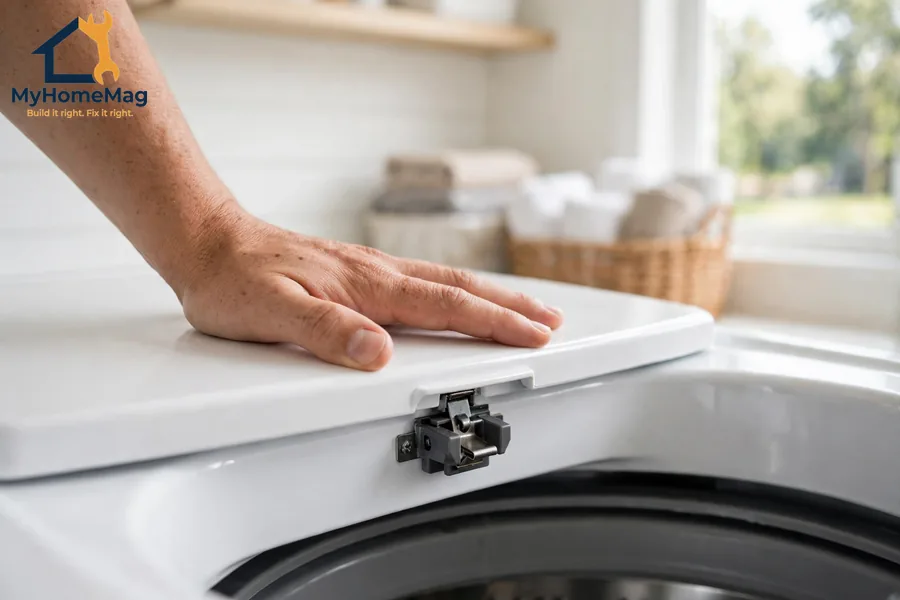
The lid has to lock before the machine will spin. This is a safety rule built into every modern washer, and it is also a common failure point.
Close the lid firmly and start a spin cycle. Listen for a click within a few seconds — that is the lock engaging; many machines also show a lid-locked light. If you hear no click, or the light flashes and the machine stops, the lock or its switch may have failed.
First, check the obvious. Look at the lid strike — the small tab on the lid that presses into the lock — and check that it is not bent, cracked, or coated in detergent residue. Wipe the lock opening clean. On a front-load machine, check the door seal for a sock or a small item caught in the rubber, and push the door firmly shut until it clicks.
Try the cycle once more. If the lid still will not lock, do not tape the switch down or wedge anything into the lock. A lid switch or lock replacement often costs roughly $150 to $250 installed in the US — a planning range, not a quote — and a technician can fit it without opening the drum.
Check 3: Is the Machine Draining at All?
Before you blame the spin, check whether the water is leaving at all. A washer will not spin a full tub, so a partial drain blockage can look exactly like a spin failure. Listen during the drain part of the cycle: you should hear the pump hum and water moving through the hose. If the water level does not fall, the drain filter or the hose may be partly blocked.
The filter sits behind a small access panel at the front bottom of most front-load machines, and on some top-load models behind a lower panel. Put a shallow tray and towels under it, because water will come out when you open it. Unscrew the filter slowly, pull out lint, coins, hair ties, and anything else trapped there, rinse it, and put it back. Check that the drain hose behind the machine is not kinked, crushed, or pushed too far down the standpipe — it should sit a few inches into the pipe, not jammed to the bottom.
The full drain diagnosis — pump testing, hose replacement, and when the pump itself has failed — belongs in our companion guide on a washer that will not drain. If cleaning the filter and straightening the hose gets the water moving and the spin works, you are done.
Check 4: The Drive Belt and the Motor — What You Can Check Safely
If the load is balanced, the lid locks, and the machine drains, but the drum still does not turn, the problem is in the drive — the parts that connect the motor to the drum.
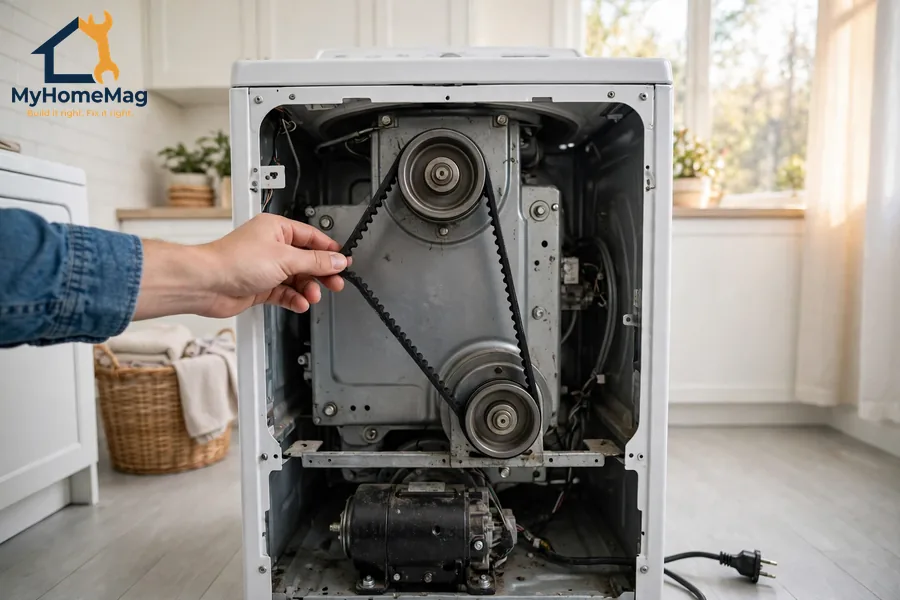
Unplug the machine first. On many top-load washers, the belt is reached through the rear panel, held by a few screws. Look at the belt: a healthy belt is tight and free of cracks, fraying, or black dust. A belt that is loose, glazed shiny, or shedding dust is slipping, and a belt that has snapped or slipped off its pulley will leave the motor humming while the drum sits still.
Do not try to run the machine with the panel off to watch the belt. If the belt looks worn or broken, that is as far as a home check should go — a belt replacement often costs roughly $150 to $250 installed, and a technician can check the pulleys and the motor at the same time.
Some top-load models have no belt: a small plastic motor coupling connects the motor to the transmission instead. When it breaks, the motor runs and the drum does not move, and you may notice a burning smell or small pieces of rubber under the machine. Reaching it means removing the cabinet, so it is a technician job — and if you smell burning, unplug the machine and do not run it again.
Check 5: Shaking, Walking, and Leveling
A washer that shakes violently, bangs, or walks across the floor during spin is usually telling you about balance or suspension, not about the motor.
Put a level on top of the machine, front to back and side to side. A washer that is not level will throw every load off balance. Adjust the feet — most screw up or down by hand, with a lock nut to hold them — until the machine is level and does not rock when you push a corner. Tighten the lock nuts so the feet cannot drift back.
If the machine is level and still shakes hard on every spin, the suspension may be worn — suspension rods on a top-load machine, shock absorbers on a front-load. A broken rod or worn shock lets the tub swing too far, and the machine stops the spin to protect itself. Press the tub down gently: it should bounce once and settle. Suspension rod replacement often costs roughly $200 to $350 installed.
Check 6: Error Codes and a Simple Reset
Modern washers display error codes for a reason, and the code is the fastest way to separate a lid problem from a motor problem from a drain problem. Write down the exact code and look it up in the manual, or on the manufacturer’s support site for your exact model number — on a sticker inside the door or on the back. Do not guess from a code for a different brand: the same code can mean different things on different machines.
One reset is worth trying for a control glitch. Unplug the machine for a full minute, plug it back in, and run a short spin-only cycle with the drum empty. If it spins normally, the control board likely glitched and the machine is fine. If the same code returns, or the machine stops at the same point again, do not keep resetting it. A control board replacement often costs roughly $300 to $500 installed, and on an older machine that cost is the point where pricing a replacement starts to make sense.
What Repairs Cost, and When Replacement Makes More Sense
Treat every figure as an approximate US planning range, not a quote, and get a written estimate before authorising work.
| Repair | Approximate planning range (installed) |
| Lid lock or lid switch | $150 to $250 |
| Drive belt | $150 to $250 |
| Motor coupling | $150 to $250 |
| Drain pump | $200 to $300 |
| Suspension rods or shocks | $200 to $350 |
| Control board | $300 to $500 |
Age matters as much as price. On a washer under eight years old, a lid switch, belt, or coupling is usually worth fixing. On a machine over ten years old, or when two expensive parts fail at once, the repair can cost half the price of a new machine. If a technician quotes more than half the cost of a comparable new washer, ask for the numbers in writing before deciding.
Preventing Standing Water in the Future
Most spin failures are preventable with three habits. Never overload the drum — fill it loosely, leaving room for the clothes to move. Clean the drain filter every month or two, and check pockets before every wash: coins, hair ties, and small items are the most common things found in a blocked filter. Run a hot cleaning cycle once a month, leave the lid or door open between washes so the drum dries out, and re-level the machine once a year — feet drift and floors settle.
Your Quick Plan
If the tub is full of water and the washer will not spin, work through this order and stop as soon as it spins:
- Bail out enough water to reach the clothes, then redistribute the load and remove half of it if the drum is packed.
- Close the lid firmly, listen for the lock click, and run a spin-only cycle.
- Clean the drain filter and straighten the drain hose.
- Unplug the machine and check the drive belt for wear, looseness, or black dust.
- Level the machine and check that the tub settles after one bounce.
- Note any error code, try one unplug-and-reset, and retry once.
If the drum spins after any step, run one full cycle with a small load to confirm the fix. If it still will not spin, call a technician with the error code and the checks you already tried.
Frequently Asked Questions
Why is there water stuck in my washing machine?
Water stuck in washing machine drums most often means the spin cycle never ran. The drum needs to spin to throw water out of the clothes, so if the load was unbalanced, the lid did not lock, or the drive belt slipped, the water stays in the tub. If the drum spun normally and the water stayed, the drain is the problem instead.
Can I drain the water manually?
Yes. Bail most of it out with a jug, then use the drain hose or the filter access panel at the front bottom of the machine to release the rest into a shallow tray. Keep towels ready, and do not tip the machine while the tub is full.
Why does my washer fill with water but not spin?
A washer fills, washes, and then needs three things to spin: a locked lid, a balanced load, and a working drive. The lid lock is the most common failure, followed by an unbalanced load and a worn drive belt. Redistribute the load first, then listen for the lid-lock click.
Is it safe to bypass the lid lock?
No. Never bypass the lid lock or the lid switch. It stops the drum from spinning while the lid is open, and a spinning drum can injure a hand in a fraction of a second. If the lock has failed, replace it — a technician can fit it quickly.
When should I call a professional instead of checking myself?
Call a professional if the lid will not lock, the belt is broken, the motor hums but the drum does not move, or the same error code returns after a reset. Call sooner for burning smells, sparking, or damaged wiring — and unplug the machine in the meantime.
Related Guides
- MyHomeMag homepage
- Appliance Guides category
- Washing Machine Leaking: Find the Source, Stop the Water, and Fix It Safely
- Dishwasher Not Draining? Causes, Fixes, and When to Call a Pro
- Bosch Dishwasher Not Draining? Causes, Safe Checks, and When to Call a Pro
- Fridge Not Cooling but Freezer Works? Causes and Safe Checks
- Washing Machine Not Draining? Filter, Pump, and Hose Checks
- Dryer Not Heating? Electric and Gas Checks to Try First
- Dryer Takes Too Long to Dry? Vent and Airflow Fixes to Try
- Washing Machine Shaking Violently? Level It and Stop the Banging

9 Responses