
You reach for ice and find an empty bin, or a bin with a few small, hollow cubes and nothing since. It is a small annoyance that turns into a daily one, and it usually has a simple cause.
Most of the time it is not a dead appliance: the freezer is still cold and the fault is in the water supply — a frozen fill tube, a shut-off valve left closed, a clogged filter, or a control arm stuck off.
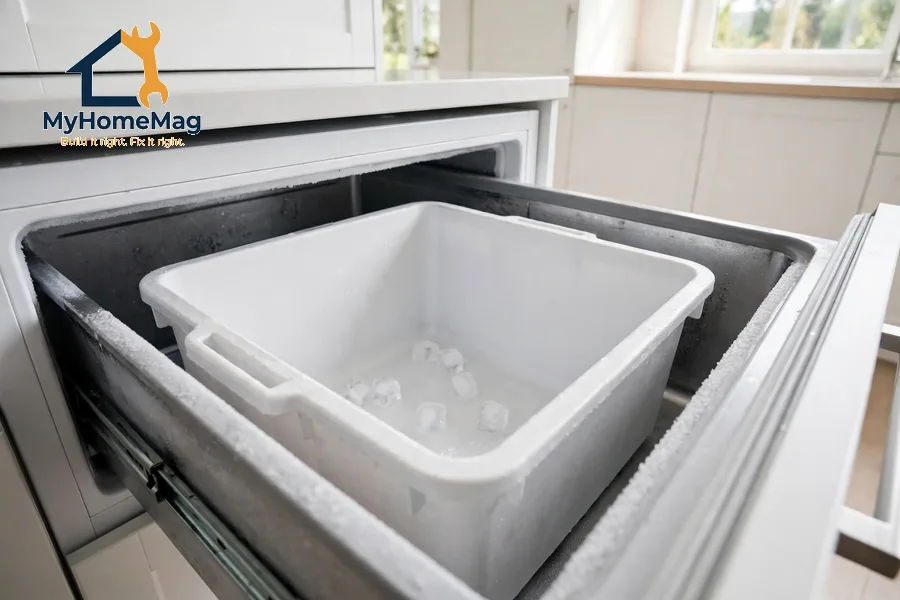
How an Ice Maker Works
An ice maker needs three things: cold air, water, and a signal to start. The freezer must be around 0°F, or the water in the mold never hardens.
Water reaches the mold through a thin supply line to a fill valve at the back, which opens for a few seconds and fills the mold through a fill tube. A metal control arm, a switch, or a sensor tells it whether the bin is full; when the arm is raised, or the switch is off, it stops even when everything else works.
First Steps When the Bin Is Empty
First, check the control arm or switch. A wire arm raised to the top means the ice maker is off — lower it gently until it sits down. On models with a switch, make sure it is on, and check the display panel has not been switched off by accident.
Second, check the freezer temperature. The US Food and Drug Administration recommends 0°F for the freezer; warmer than about 5°F, cubes come out small, hollow, or not at all. Give the freezer 24 hours after any change before you judge the result.
Third, check whether the fridge was recently moved, the water shut off, or a filter changed. If the water dispenser also gives nothing, or only a slow trickle, the problem is the water supply, not the ice maker.
Common Causes at a Glance
| Cause | What you notice | First safe check |
| Ice maker switched off | Arm raised, or switch off | Lower the arm / switch it on |
| Freezer too warm | Small or hollow cubes, then none | Check the temperature is 0°F |
| Frozen fill tube | No water reaches the mold | Look for ice in the fill tube |
| Water supply off or kinked line | Dispenser slow or dead too | Check the shut-off valve and line |
| Clogged water filter | Slow dispenser, small cubes | Replace the filter |
| Faulty water inlet valve | No water, but supply is fine | Listen for a hum when it should fill |
| Broken ice maker module | Mold fills, but cubes never eject | Watch a full harvest cycle |
| Worn door gasket | Frost builds up, freezer warms | Paper test the door seal |
Use this table to pick your starting point, then work through the checks in order. Do not skip the easy ones: a raised control arm looks exactly like a broken valve until you lower it.
Safety First: Before You Touch Anything
An ice maker fault is usually low risk, but water and electricity still meet behind the fridge. Unplug the fridge before you remove any panel or cover, since fans and heaters can start without warning.
Find the water shut-off valve before you loosen any water fitting — usually behind the fridge, under the sink, or in the basement below — and keep towels and a bucket ready. Never chip ice out with a knife or screwdriver, and do not use a hair dryer on high heat inside the freezer. If you smell burning, see sparking, or find damaged wiring, stop and call a professional. Check your warranty terms before removing parts.
Check 1: The Control Arm, Switch, and Bin
On many models, a thin metal arm hangs down from the ice maker into the bin. When the bin fills, the rising ice lifts the arm and switches it off; when you empty the bin, the arm should fall again. Sometimes it sticks raised, or gets caught on a bag of frozen food. Lower it gently by hand and listen for a click, then wait: a full bin takes about 24 hours to build from empty.
On models without an arm, look for a small on-off switch or a display-panel setting. Also check the bin: one not pushed fully home can hold the arm up or block the sensor. Remove it, clear any jammed ice, and slide it back until it seats.
Check 2: Freezer Temperature and Airflow
Set the freezer to 0°F and check it with a thermometer left inside for a few hours, rather than trusting the display alone. Food can feel hard at 10°F, but an ice maker at that temperature makes small, cloudy cubes slowly, or stops altogether.
Airflow matters too: a freezer packed tight blocks the vents that carry cold air to the ice maker, so leave space around the back vents and keep the door closed for a full day after changing the temperature. Thick frost around the ice maker points to warm air leaking in through a worn door gasket. If the freezer still will not hold 0°F after a day, a technician should look at it.
Check 3: The Frozen Fill Tube
The fill tube is the short tube that drops water from the back of the freezer into the ice mold. It is narrow, it sits in freezing air, and it is the most common cause of an ice maker stopped making ice when the freezer is cold and the water supply is on. If ice blocks its opening, water cannot reach the mold.
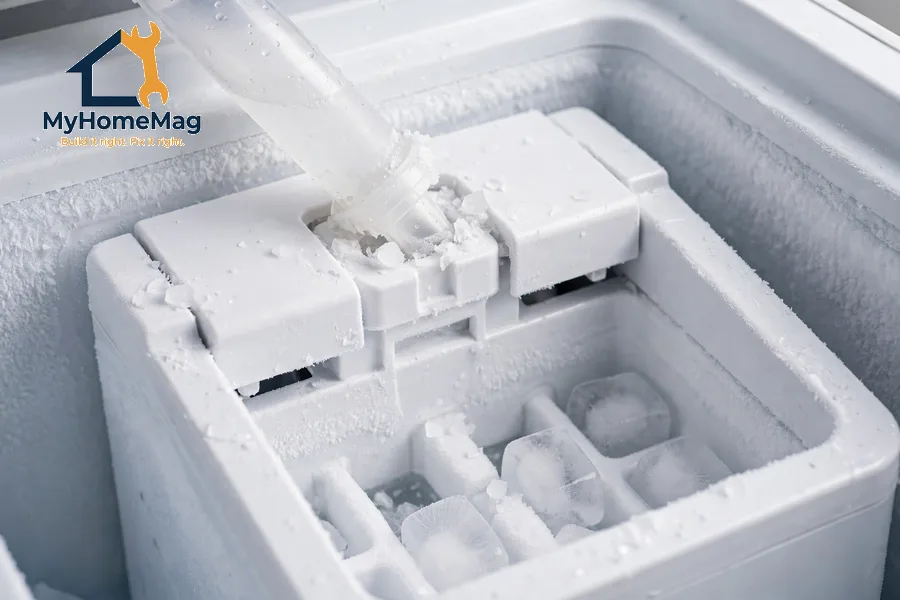
The safe fix is gentle warmth. Unplug the fridge, then press a cloth soaked in warm — not boiling — water against the tube for a few minutes, or hold a hair dryer on its lowest setting at a distance. Never pour boiling water into the freezer, and never chip at the ice with a tool. Once the tube is clear, run a manual test cycle if your model has one; if water flows into the mold, the tube was the problem. If it freezes again within a few weeks, the inlet valve may be letting a slow trickle through — a job for a technician, since it is an electrical part under water pressure.
Check 4: The Water Supply Line and Shut-Off Valve
If the water dispenser is also slow or dead, the ice maker is probably fine — it is simply not getting water. Find the shut-off valve for the fridge line, often on a cold-water pipe in the basement, under the sink, or behind the fridge, and make sure it is fully open. A valve closed for a repair or a filter change and never reopened is a common cause, and it costs nothing to fix.
Next, look at the supply line itself. Pull the fridge out carefully, with someone helping: a plastic line that is kinked, flattened, or yellowed and brittle with age can starve the ice maker even when the valve is open. Do not straighten a brittle line and reuse it — replace it. While you are there, check the back connection for drips, and tighten a loose fitting gently; do not overtighten, since a cracked fitting leaks worse.
Check 5: The Water Filter
A clogged water filter is easy to miss: the fridge keeps cooling and the ice maker keeps trying, but it gets too little water to fill the mold. Most refrigerators with a water dispenser have a replaceable filter inside the fresh-food section or in the base grille, changed about every six months, or sooner if the dispenser flow has slowed.
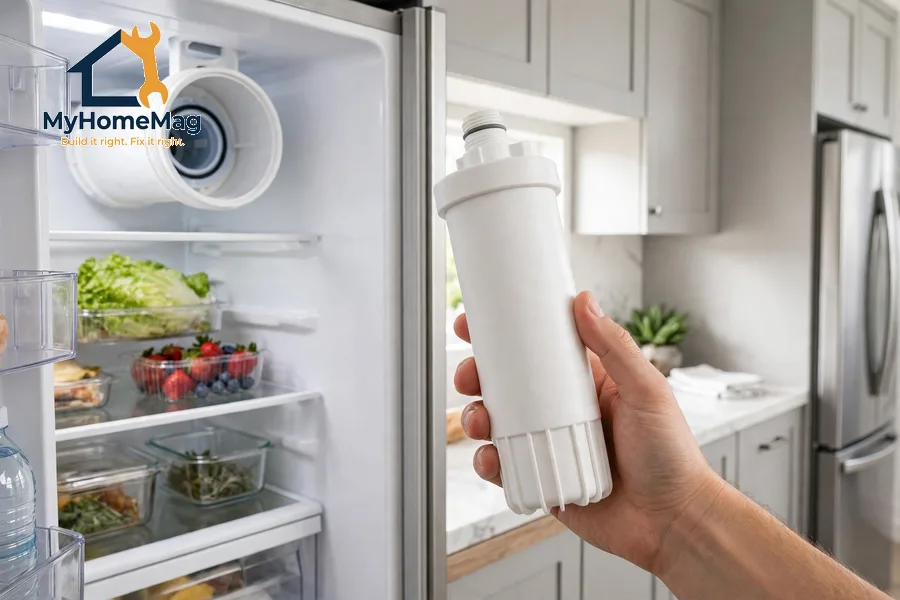
A filter past its life gives a partial fill: small, hollow cubes, or a mold that never fills enough to harvest. If you changed the filter recently and the ice maker stopped right after, check that the new filter is fully seated — turn it until it clicks — and that you removed any protective cap. Run the dispenser for a few seconds after fitting a new filter and watch for drips around the housing; a cracked housing needs replacing. Do not run the fridge with the filter removed and no bypass plug fitted, or water can spray from the empty housing.
Check 6: The Water Inlet Valve
The water inlet valve sits at the back of the fridge, where the supply line connects. It opens for a few seconds each time the ice maker calls for water, then closes. When it fails, the ice maker gets nothing even though the supply, line, and filter are fine.
Test it by listening: when the ice maker should be filling — a few minutes after you lower the control arm, or during a manual test cycle — listen near the back of the fridge for a short hum or buzz. No sound at all, after the supply has been checked, points to a valve that is not opening. Do not test the valve by loosening a water fitting while the fridge is plugged in: it is an electrical part under mains water pressure. A valve that lets a slow trickle through when it should be closed — showing up as a fill tube that keeps freezing, or a mold that overflows — also needs a technician.
Check 7: The Ice Maker Module Itself
If water reaches the mold, the freezer is cold, and the control is on, but no ice ever appears, the ice maker module itself may have failed. Watch a full cycle: a working ice maker fills the mold, freezes the water, then a small motor turns the ejector arms and pushes the cubes into the bin. If the mold fills but the cubes never eject, the motor or the thermostat may have failed; if the mold never fills, the fault is upstream — go back to Checks 3 to 6.
Look for visible damage first: a cracked mold, ejector arms that are bent or stuck, or ice jammed around the mechanism. Clear any jammed ice by hand, with the fridge unplugged, and try a manual test cycle if your model has one. If nothing moves, the module is usually replaced as a unit rather than repaired part by part, often roughly $150 to $350 installed, and it is a job many owners leave to a technician.
What Repairs Cost, and When Replacement Makes More Sense
Treat every figure as an approximate US planning range, not a quote, and get a written estimate before authorising work.
| Repair | Approximate US range (installed) |
| Water filter replacement | $30–$60 for the filter |
| Supply line replacement | $100–$200 |
| Door gasket replacement | $100–$250 |
| Ice maker module replacement | $150–$350 |
| Water inlet valve replacement | $150–$300 |
| Fill tube thaw and valve check | $100–$200 |
Most ice maker faults are cheap to fix, and a professional visit is usually a one-hour job. Replacing the whole fridge only makes sense when the empty bin comes with other problems: the fridge is over fifteen years old, it is also not cooling, or the repair costs more than half of a comparable new fridge.
Preventing the Next Empty Bin
Change the water filter every six months, and check the dispenser flow at the same time — a slowing flow is the earliest warning that the ice maker is next. Keep the freezer at 0°F, leave the vents clear, and do the paper test on the door gasket twice a year. Check behind the fridge once a year for kinks, yellowing, or drips, and make sure the shut-off valve turns freely.
When to Call a Professional
Call a professional if the fill tube keeps freezing after you clear it, the inlet valve makes no sound when it should fill, the mold fills but the cubes never eject, or you cannot shut off a damaged water line. Call sooner if water has reached the power cord, outlet, or floor, or if you smell burning or see damaged wiring. Before the visit, note what you tried: whether the dispenser works, whether the freezer holds 0°F, and whether the valve hums during a fill cycle.
If the fridge is also warm, the problem may be bigger than the ice maker: a fridge not cooling but freezer works pattern points to airflow or a fan fault instead.
A Simple Plan to Follow
Check the control arm and the freezer temperature first, then the water supply: shut-off valve, supply line, and filter. Then check the fill tube for ice, listen for the inlet valve, and watch the ice maker module itself. Stop at the first check that explains the empty bin, and give the ice maker 24 hours after any fix — a full bin takes a day to build from empty.
Frequently Asked Questions
Why did my ice maker suddenly stop making ice?
The most common sudden causes are a control arm knocked off, a shut-off valve closed during other work, a clogged filter, or a frozen fill tube. Check those four before assuming a part has failed.
How long does it take for an ice maker to start making ice again?
After a fix, allow about 24 hours for a full bin. The first cubes usually appear within a few hours, but a bin builds slowly, one harvest at a time.
Why is my ice maker making small or hollow cubes?
Small or hollow cubes usually mean the mold is only partly filling — a clogged filter, low water pressure, a kinked line, or a freezer that is not cold enough. Replace the filter first, then check the line and the temperature.
Can a bad water filter stop an ice maker?
Yes. A filter past its life restricts water flow, so the mold never fills properly. Change the filter every six months, and check that a new filter is fully seated until it clicks.
How much does it cost to fix an ice maker that stopped making ice?
A filter or a supply line is often the cheapest fix, roughly $30 to $200. A replacement module or inlet valve usually falls in an approximate US range of $150 to $350 installed. Get a written estimate first, and compare it with the age of the fridge.
Related Guides
- MyHomeMag
- Appliance Guides
- Fridge Not Cooling but Freezer Works? Causes and Safe Checks
- Refrigerator Leaking Water Inside? Causes and Safe Fixes
- Refrigerator Door Gasket Replacement: Fit, Cost, and Testing
- Washing Machine Leaking: Find the Source, Stop the Water, and Fix It Safely
- Freezer Frosting Up? Causes, Defrost Steps, and Prevention
- Fridge Not Cold but Freezer Is? Checks to Try Before a Pro
- Water Stuck in Washing Machine? Why It Won’t Spin and What to Check
- Washing Machine Not Draining? Filter, Pump, and Hose Checks
- Dryer Not Heating? Electric and Gas Checks to Try First
- Dryer Takes Too Long to Dry? Vent and Airflow Fixes to Try
- Washing Machine Shaking Violently? Level It and Stop the Banging
5 Responses