
Your dryer runs, the drum turns, and the cycle finishes — but the clothes come out just as damp as they went in. A dryer not heating is frustrating because the machine looks like it is working. In fact, the tumbling and the heating are two separate jobs, and the checks below work through them in order, from the free ones first.
The first question is whether your dryer heats at all. If it gets warm but takes two or three cycles to dry a load, that is a different problem — slow drying, usually a vent or airflow issue — and it will be covered in our companion guide on a dryer that takes too long to dry. This guide covers the other case: a dryer that tumbles but produces no heat, or only a little heat at the start and then goes cold. In other words, if the air inside the drum never gets hot, start here. If the machine holding water is your washer rather than your dryer, start with our guides on a washing machine not draining and on water stuck in a washing machine instead — the checks below are for a dryer that tumbles but makes no heat.
The second question is whether your dryer is electric or gas, because the parts that make heat are completely different. An electric dryer heats with a coiled heating element, like a toaster. A gas dryer heats with a burner, lit by an igniter and fed by gas valve coils. The checks below say clearly which type each step applies to, so skip the ones that do not match your machine. If you are not sure which type you have, check the back of the dryer: a gas dryer has a gas supply line and a shut-off valve, while an electric dryer has a large three- or four-prong plug and no gas line.
How Your Dryer Actually Makes Heat
A dryer needs three things to heat: power or gas, airflow, and a working heat source. When any one of them fails, the drum still tumbles — the motor is on a separate circuit — but no warm air reaches the clothes.
On an electric dryer, power flows through a thermal fuse and a high-limit thermostat, then through the heating element. The element glows hot, and the blower pushes that warm air through the drum and out through the vent. On a gas dryer, gas flows through the valve coils to the burner, the igniter glows and lights the gas, and the same blower moves the warm air through the drum. In both types, a blocked vent or a tripped thermal fuse can shut the heat off while the drum keeps turning, which is why the first checks below are about airflow and power before any part is blamed.
That order is why the checks below start with the vent and the power supply — the two places where a fix is most likely and cheapest — before the heating element, the thermal fuse, and the gas parts, which are technician jobs on most machines.
Common Causes at a Glance
| Cause | What you may notice | First safe check |
| Blocked vent or lint build-up | Dryer warm at first, then cold; long drying times before this | Clean the lint filter and check the vent |
| Tripped breaker or partial power loss (electric) | Drum turns but no heat at all | Check both breaker switches |
| Blown thermal fuse | No heat, dryer may stop mid-cycle | Check for a blocked vent first, then call a technician |
| Failed heating element (electric) | No heat, drum tumbles normally | Listen and feel for heat; element is a technician job |
| Failed igniter or gas valve coils (gas) | No heat, no glow or flame sound | Watch for the igniter glow; gas parts are a technician job |
| Faulty cycling thermostat | Heat comes and goes, or never starts | Note the pattern, then call a technician |
| Wrong cycle or heat setting | No heat on one setting only | Try Timed Dry on High Heat |
| Gas supply off (gas) | No heat, no igniter glow | Check the gas shut-off valve is open |
This table is a starting point, not a diagnosis. The checks below follow the same order.
Safety First: Before You Touch Anything
A dryer mixes heat, mains electricity, and — on gas models — flammable gas. Use this short checklist before any check below:
- Unplug an electric dryer before removing any panel or touching the heating element, thermal fuse, or wiring. On a gas dryer, unplug it and turn the gas shut-off valve off before removing a panel.
- Never bypass a thermal fuse, a high-limit thermostat, or any safety device to “test” the dryer. Those parts shut the heat off for a reason, and bypassing them is a fire risk.
- If you smell gas, stop, do not switch anything electrical on or off, leave the house, and call your gas utility or emergency services from outside. Do not try to find a gas leak yourself.
- Never run a dryer with the vent disconnected into the room. The hot, damp air and lint need to go outside, and a disconnected vent is a fire and moisture risk.
- Let the dryer cool before you reach inside it. The element, burner, and drum can stay hot after a cycle.
- If you see sparking, scorch marks, or damaged wiring, stop, unplug the unit, and call a professional.
Check 1: The Lint Filter and the Vent — the Most Common Cause
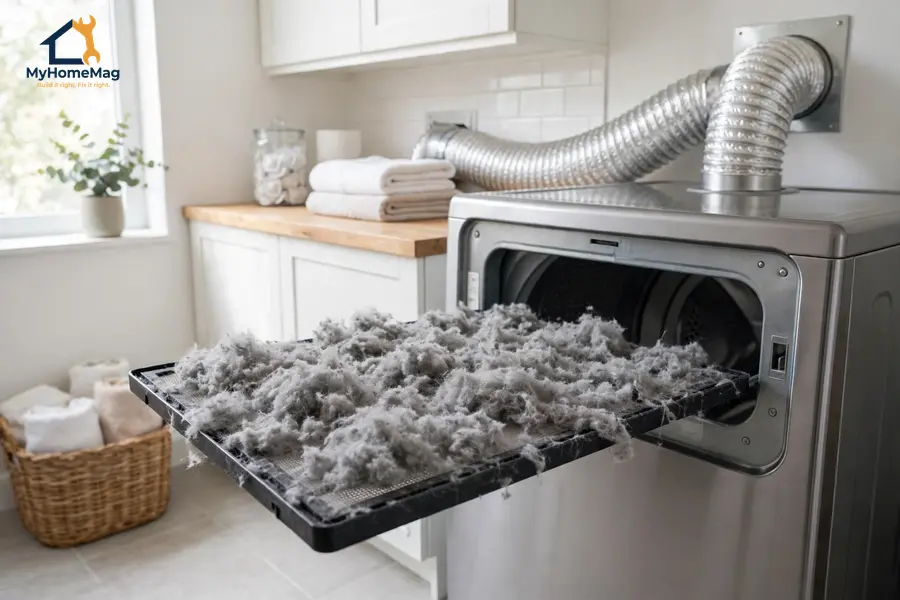
Start here: a blocked vent is the most common reason a dryer stops heating, and it costs nothing to fix. Lint builds up in the filter, in the vent hose, and in the outside vent cap, and when airflow drops, the dryer overheats, trips its thermal fuse, and then produces no heat at all — even though the drum still turns.
First, pull out the lint filter and clean it thoroughly. Hold it up to the light: if you cannot see light through the mesh, wash it with warm soapy water and a soft brush, because fabric softener residue can coat the mesh and block airflow even when it looks clean. Let it dry fully before you put it back.
Next, check the vent hose behind the dryer. Pull the dryer out just enough to see it — do not crush the hose against the wall when you push it back. The hose should run in a smooth, short path to the outside, with no sharp bends, no sagging loop, and no crushing. A flexible foil or plastic hose that is kinked or crushed is a common culprit, and a rigid metal vent is the safer replacement if yours is damaged.
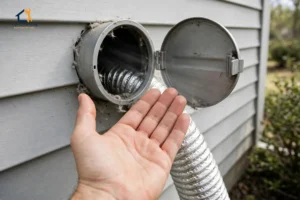
Finally, check the outside vent cap while the dryer runs on a no-heat or air-fluff cycle. You should feel a strong flow of air. If the flow is weak, or the cap flap barely moves, the vent is blocked somewhere along its length. Lint trapped inside a long vent run is a technician or vent-cleaning job, not a DIY snake job — pushing a brush through from the wrong end can pack the lint tighter.
Check 2: The Cycle, the Setting, and the Power Supply
Before you blame a part, rule out the simple explanations. They account for more “dead dryer” calls than most owners expect.
First, try a different cycle. Run the dryer on Timed Dry at High Heat with a small load. If it heats on Timed Dry but not on an automatic or sensor cycle, the moisture sensor may be misreading a damp load — try a smaller load and clean the sensor bars inside the drum with a little vinegar on a cloth. If it heats on no setting at all, the problem is in the power or heat parts below.
For an electric dryer, check the power supply next. An electric dryer needs 240 volts, supplied through two breaker switches, and the drum motor runs on only one of them. That means a tripped breaker can leave the drum turning while the heating element gets no power at all — the classic sign of a dryer not heating on an electric model. Open your breaker panel and find the pair for the dryer. If one switch has tripped, flip it fully off and then fully on. If it trips again straight away, stop and call an electrician — do not keep resetting it.
For a gas dryer, check that the gas shut-off valve behind the dryer is fully open, with the handle in line with the pipe. If the valve was turned off during a move or a repair and never turned back on, the igniter will glow but no gas will reach the burner. If the valve is open and there is still no heat, move on to Check 5 — do not try to test the gas supply yourself.
Check 3: The Thermal Fuse — Why a Blocked Vent Kills the Heat
The thermal fuse is a small safety device, usually on the blower housing or the exhaust duct, that cuts power to the heating element or burner when the dryer overheats. Once it blows, it does not reset — the dryer will tumble but never heat again until the fuse is replaced.
A blown thermal fuse is almost always a symptom, not the root cause. In most cases, the vent was blocked first, the dryer overheated, and the fuse did its job. That is why Check 1 comes first: if you replace the fuse without clearing the vent, the new fuse will blow again on the next load.
Reaching the thermal fuse means removing a panel and working near wiring, so on most machines it is a technician job. One check you can do safely is the vent check above — a strong airflow at the outside cap after cleaning the filter tells you the vent is clear, and that information helps the technician. If the fuse has blown, a technician can test it, replace it, and check the vent in the same visit. A thermal fuse replacement often costs roughly $100 to $200 installed.
Check 4: The Heating Element (Electric Dryers Only)
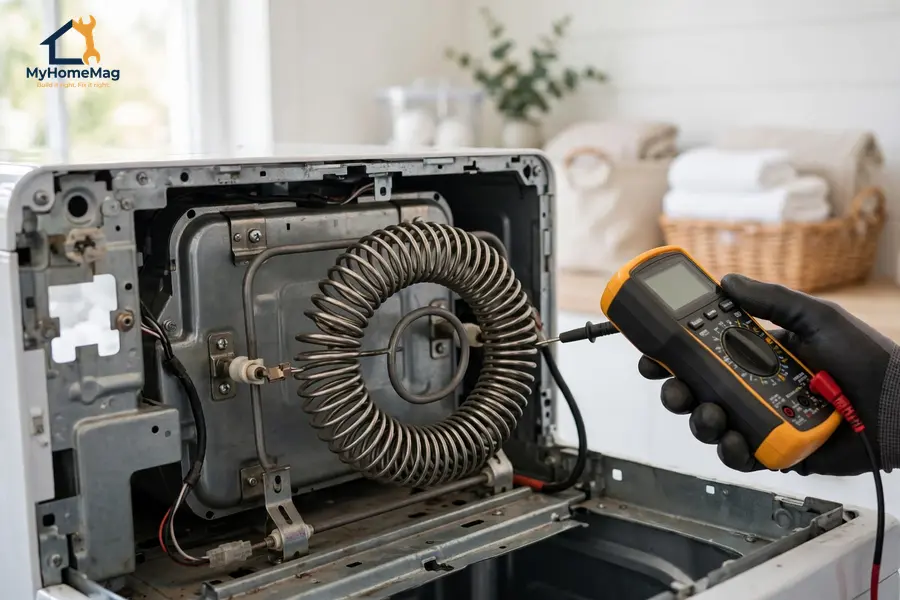
On an electric dryer, the heating element is a coil of wire inside a metal housing. When it works, it glows red-hot; when it breaks, the circuit opens and no heat is produced at all, while the drum keeps turning normally.
You can sometimes spot a broken element without taking the dryer apart, but only by looking, not by touching. With the dryer unplugged and cool, and the back or front panel removed only if your manual shows how, look for a coil that is broken, sagging, or touching the metal housing. A coil that has snapped, or one with a visible gap, has failed. Do not touch the coil, and do not run the dryer with a panel off to “watch” it heat — that is how burns and shocks happen.
In practice, testing and replacing a heating element is a technician job on most models, because it means working inside the machine near high-voltage wiring. Tell the technician whether the dryer ever heated at all, and whether it stopped suddenly or faded over weeks — a sudden stop points to the element or the fuse, while a slow fade points to the vent or the thermostat. A heating element replacement often costs roughly $150 to $300 installed.
Check 5: The Igniter and Gas Valve Coils (Gas Dryers Only)
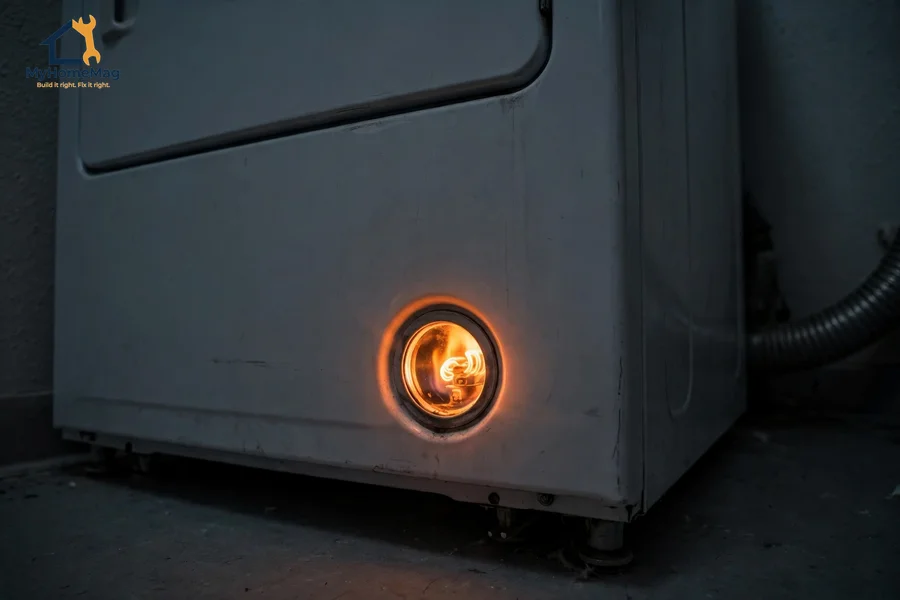
On a gas dryer, the igniter is a small ceramic part that glows white-hot to light the gas, and the gas valve coils open the valve so gas can flow to the burner. If either one fails, the burner never lights, and the dryer tumbles with cold air.
You can watch for the igniter glow safely, without removing anything. Start a heated cycle, then look through the small inspection window or peep hole on the front of the dryer — most gas dryers have one near the bottom. Within a minute or so, you should see a bright orange glow, followed by a soft whoosh as the burner lights. If you see the glow but no flame follows, the gas valve coils are the likely fault. If you see no glow at all, the igniter itself has likely failed. If you see no glow and smell gas, stop, leave the house, and call your gas utility from outside.
Do not remove the burner cover or test gas parts yourself. Gas valve coils and igniters are technician jobs, and a gas leak is not a DIY diagnosis. A gas valve coil replacement often costs roughly $150 to $250 installed, and an igniter replacement often costs roughly $150 to $250 installed.
Check 6: The Cycling Thermostat and a Simple Reset
The cycling thermostat controls how hot the drum gets, turning the heat on and off as the load dries. When it fails, the dryer may heat once and then go cold, heat weakly, or never heat at all. A faulty thermostat is hard to separate from a failed element or fuse without a meter, so note the pattern: heat that starts and then stops early in the cycle points to the thermostat or the thermal fuse, while no heat from the very start points to the element, the igniter, or the power supply.
One reset is worth trying for a control glitch. Unplug the dryer for a full minute — and on a gas dryer, turn the gas off first — then plug it back in and run a short Timed Dry cycle on High Heat with the drum empty. If it heats normally, the control board likely glitched and the dryer is fine. If the same fault returns, or the dryer never heats, do not keep resetting it. A control board replacement often costs roughly $300 to $500 installed, and on an older dryer that cost is the point where pricing a replacement starts to make sense.
What Repairs Cost, and When Replacement Makes More Sense
Treat every figure as an approximate US planning range, not a quote, and get a written estimate before authorising work.
| Repair | Approximate planning range (installed) |
| Vent cleaning (professional) | $100 to $200 |
| Thermal fuse | $100 to $200 |
| Heating element (electric) | $150 to $300 |
| Igniter (gas) | $150 to $250 |
| Gas valve coils (gas) | $150 to $250 |
| Cycling thermostat | $120 to $200 |
| Control board | $300 to $500 |
Age matters as much as price. On a dryer under ten years old, a fuse, an igniter, or an element is usually worth fixing. On a machine over twelve years old, or when two expensive parts fail at once, the repair can cost half the price of a new dryer. If a technician quotes more than half the cost of a comparable new dryer, ask for the numbers in writing before deciding. A new dryer that heats properly also uses less energy than an old one fighting a blocked vent, so factor the running cost in as well.
Preventing Heating Problems in the Future
Most dryer heating failures are preventable with three habits. Clean the lint filter after every load, and wash it with soapy water every few months so fabric softener residue does not block the mesh. Check the vent hose once a year for kinks, crushing, or sagging, and have the full vent run cleaned professionally every year or two — more often if you dry heavy loads or pet bedding. Finally, do not overload the drum: a packed drum blocks airflow, overheats the dryer, and trips the thermal fuse, which is exactly the failure this guide starts with.
Your Quick Plan
If the drum turns but the dryer is not heating, work through this order and stop as soon as it heats:
- Clean the lint filter, wash it if light will not pass through it, and check the vent hose and outside cap for airflow.
- Try Timed Dry on High Heat with a small load, to rule out a sensor or cycle problem.
- On an electric dryer, check both breaker switches — a tripped breaker can leave the drum turning with no heat. On a gas dryer, check the gas shut-off valve is open.
- If the vent was blocked, remember the thermal fuse may have blown — that is a technician job, and the vent must be cleared first.
- On a gas dryer, watch the inspection window for the igniter glow — glow with no flame points to the gas valve coils; no glow points to the igniter.
- Try one unplug-and-reset, then retry once. If the dryer still will not heat, call a technician with the pattern you saw.
If the dryer heats after any step, run one full cycle with a small load to confirm the fix. If it still will not heat, call a technician with the dryer type (electric or gas), what you saw at the inspection window or breaker panel, and the checks you already tried.
Frequently Asked Questions
Why is my dryer not heating but the drum still turns?
A dryer not heating while the drum turns usually means the heat source has failed while the motor still works. On an electric dryer, the usual causes are a tripped breaker, a blown thermal fuse, or a failed heating element. On a gas dryer, the usual causes are a failed igniter or gas valve coils. A blocked vent can cause any of these by overheating the dryer first.
Why does my dryer heat for a few minutes and then go cold?
Heat that starts and then stops usually means the dryer is overheating and a safety device is cutting in, or the cycling thermostat is faulty. Clean the lint filter and check the vent for a blockage first, because a blocked vent is the most common cause. If the vent is clear and the problem returns, call a technician — do not bypass the thermal fuse to keep it running.
How do I know if the heating element is broken?
On an electric dryer, a broken heating element usually means no heat at all from the start of the cycle, while the drum turns normally. A technician can test the element with a meter and check for a visible break in the coil. Do not run the dryer with a panel off to watch the element heat — that is a burn and shock risk.
Can a clogged vent stop a dryer from heating?
Yes. A clogged vent restricts airflow, the dryer overheats, and the thermal fuse blows to protect it. Once the fuse blows, the dryer will tumble but never heat again until the fuse is replaced — and the vent must be cleared first, or the new fuse will blow again.
Is it safe to run a dryer that is not heating?
It is safe to run one test cycle to check whether it heats, but do not keep running a dryer that will not heat. Repeated cycles waste energy, and if the cause is a blocked vent or a faulty safety device, running it further can overheat the machine. Unplug it and call a technician if the checks above do not fix it.
Related Guides
- MyHomeMag
- Appliance Guides
- Washing Machine Not Draining? Filter, Pump, and Hose Checks
- Water Stuck in Washing Machine? Won’t-Spin Checks to Try First
- Washing Machine Leaking: Find the Source, Stop the Water, and Fix It Safely
- Dishwasher Not Draining? Causes, Fixes, and When to Call a Pro
- Dryer Takes Too Long to Dry? Vent and Airflow Fixes to Try
- Washing Machine Shaking Violently? Level It and Stop the Banging


3 Responses