
A dishwasher that suddenly starts grinding, rattling or humming is hard to ignore — and it is usually trying to tell you something specific. Unlike a dishwasher that simply will not drain, or one that leaves dishes dirty, a grinding noise is a sound fault: something is caught where it should not be, rubbing where it should not rub, or wearing out. The most common cause is also the cheapest to fix — a small piece of debris caught in the filter or the pump — but debris, a blocked spray arm and a worn motor all sound similar at first.
This guide is about the noise itself. It is not a drain guide and it is not a cleaning guide. If your dishwasher fills with standing water and will not drain, that is a different fault, covered in our guide on a dishwasher not draining. If it leaks from the bottom, that is a different fault too — see our guide on a dishwasher leaking from the bottom. And if your dishes come out dirty, the cleaning guide covers that. Here, the question is narrower: why is the dishwasher making a grinding noise, is it safe to keep running, and what should you do about it?
The short answer is that most grinding noises come from debris — a piece of broken glass, a bone fragment, a fruit pit, a twist tie, or a piece of plastic — caught in the filter, the drain pump, or the spray arm. Those causes are usually fixable at home with the power and water off. A noise that continues after the filter and pump are clear, or one that gets louder over weeks, is more likely to be pump or motor wear, and that is a job for a professional. This guide shows you how to tell the difference, step by step.
A dishwasher grinding noise is most often caused by debris caught in the filter or pump, a spray arm blocked by a dish or debris, or a worn drain or circulation pump. Stop the cycle, turn the power and water off, and check the filter and spray arms first — those are the most common causes and the cheapest to fix. If the noise continues after the filter and pump are clear, stop using the machine and call a professional.
What a Grinding Noise Means — and What It Does Not
A grinding noise from a dishwasher is the sound of something hard being dragged, crushed or rubbed inside the machine. In most cases, that “something” is a small hard object that slipped past the rack and into the filter or the pump. Dishwashers are designed to handle food scraps and dirty water, but they are not designed to chew through glass, bone, metal or hard plastic. When one of those objects reaches the pump impeller — the small spinning part that moves water through the machine — the impeller strikes it again and again, and you hear a grinding or rattling sound.
However, not every dishwasher noise is grinding. A light hum when the machine first fills is often normal: that is the inlet valve opening and water flowing in. A soft swishing sound during the wash is normal too: that is the spray arms turning and water hitting the dishes. A grinding noise is different. It is harsh, mechanical and irregular, and it usually starts suddenly in the middle of a cycle, or at the start of the drain phase. If the sound is new, loud, and clearly mechanical, treat it as a fault to investigate, not as background noise to live with.
There is one more distinction worth making. A grinding noise is not the same as a dishwasher that will not drain. A machine can grind and still drain, and a machine can fail to drain without making any noise at all. If your dishwasher has standing water in the bottom after a cycle, work through our guide on a dishwasher not draining first. If the problem is the sound, and the water still drains, keep reading.
First Safe Checks You Can Do in Ten Minutes
Before you take anything apart, spend ten minutes on the checks that need no tools and no disassembly. They solve a surprising number of grinding noises, because the cause is often sitting in plain sight.
First, run the cycle and listen to when the noise happens. Does it start as soon as you press start, during the wash, or only when the machine drains? A noise that appears only during draining points toward the drain pump. A noise during the wash points toward the spray arms or the circulation pump. A noise that is constant from start to finish is more likely to be the motor. Note the timing before you open the door — it is the single most useful clue you will have.
Next, open the door and look at the racks. A tall item — a cutting board, a baking sheet, a large plate — can lean against a spray arm and stop it turning. When the arm tries to turn and cannot, it shudders and grinds against the dish. Push the racks in and out slowly and watch whether anything touches the upper or lower spray arm. If a dish is the culprit, rearranging the load fixes the noise immediately, and it costs nothing.
Then check the bottom of the tub for loose objects. A fallen knife, a small lid, or a broken piece of dishware can sit under the lower rack and rattle against the spray arm. Remove anything that does not belong there. While you are looking, check the silverware basket too — a spoon or a chopstick poking through the bottom can catch the spray arm as it turns.
Finally, run a short cycle with the machine empty, after you have removed any loose objects. If the noise is gone, the cause was the load. If it is still there, the cause is inside the machine — the filter, the pump, or the motor — and the next sections show you how to check each one safely.
Debris in the Filter and Pump — the Most Common Cause
The filter is the first place debris collects, and it is the first place to check. The filter sits in the bottom of the dishwasher tub, usually as a cylindrical or flat mesh unit that twists out by hand. Food scraps, broken glass and small hard objects collect there, and when enough builds up, a piece can work its way into the pump inlet and grind against the impeller.
To check it, turn the power off at the dishwasher’s switch or the breaker, and turn the water supply off at the shut-off valve under the sink. Then remove the lower rack, twist the filter out, and look inside the filter housing. You will often see the culprit right away: a shard of glass, a fruit pit, a bone fragment, or a piece of hard plastic. Remove it carefully — broken glass is sharp, so wear gloves and use tongs or pliers if you cannot see what you are reaching for. Rinse the filter under the faucet, scrub the mesh gently with a soft brush, and put it back, making sure it locks into place. A filter that is not seated properly can itself rattle and grind.
If the filter is clear but the noise continues, the debris may be further in, at the drain pump. The drain pump is usually reached through the same opening at the bottom of the tub, behind a small cover or grille near the filter. With the power still off, remove the cover if your model allows it — your dishwasher’s manual will show how — and look for debris around the impeller. Turn the impeller gently by hand. It should spin freely. If it catches, grinds, or will not turn, there is something in there, or the impeller itself is damaged. Remove anything you find, then put the cover back.
Two warnings apply here. First, never reach into the pump housing while the machine is plugged in or the power is on — the impeller can start without warning during a cycle. Second, do not force the impeller. If it will not turn with gentle pressure, stop. Forcing it can break the impeller or the pump shaft, and that turns a small debris job into a pump replacement.
If you clear the filter and the pump and the noise stops, run one full cycle empty to confirm, then one normal load. To stop it from happening again, scrape plates before loading, and check the filter every month or so. A clean filter is the cheapest protection a dishwasher has.
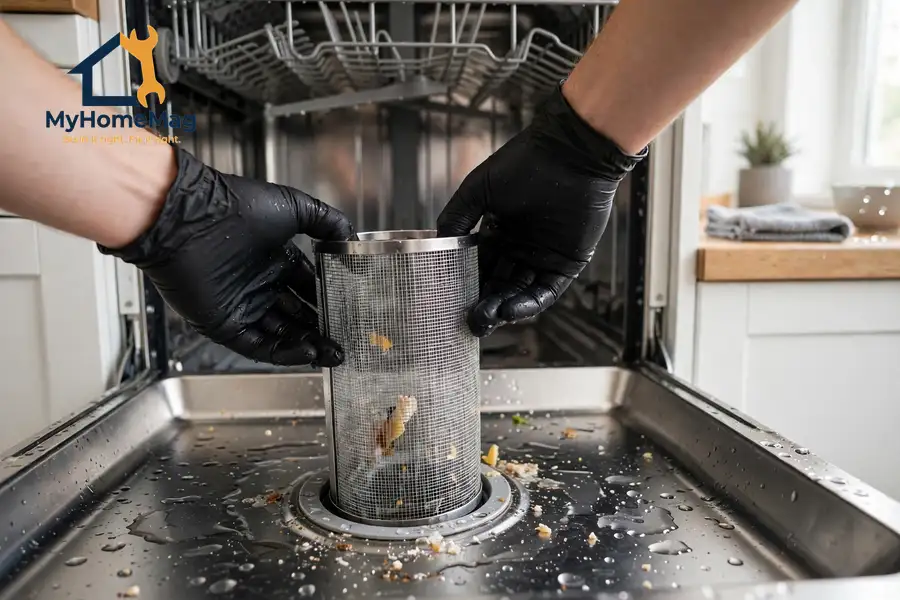
A clogged filter is the most common cause of a dishwasher grinding noise — twist it out and clear any debris before checking the pump.
Spray Arm Obstruction: When the Noise Follows the Spray
Spray arms are the parts that throw water around the tub, and they are the second most common source of grinding. A spray arm can grind for two reasons: something is blocking it from turning, or something is stuck inside it.
The first reason is the load itself. A tall glass, a long utensil, or a pan handle that hangs below the rack can stop the arm mid-turn. The motor keeps trying to turn the arm, the arm shudders against the obstruction, and you hear a rhythmic grinding or knocking sound that repeats with each turn. This is the easiest cause to fix, and it is also the easiest to misdiagnose as a pump fault — the sound can be surprisingly loud. Before you take anything apart, always check the load first, as described in the ten-minute checks above.
The second reason is debris inside the spray arm. Small seeds, grains of rice, pieces of glass and mineral deposits can get into the arm through its holes and rattle around inside as it spins. To check, remove the lower spray arm — on most models it lifts off or unscrews by hand — and shake it gently. If you hear something rattling inside, rinse it under the faucet, poke the holes clear with a toothpick or a thin wire, and shake it again until nothing rattles. Do the same for the upper spray arm, which usually unclips or unscrews from the rack.
Also check the arm itself for damage. A cracked spray arm can wobble on its mount and grind against the rack or the tub wall. A warped arm — one that has gone out of shape after years of hot water — can catch on the rack as it turns. If the arm is cracked or warped, it needs replacing. A replacement spray arm is usually an inexpensive part, and on most models it fits without tools. If you are unsure which part fits your model, note the model number from the sticker on the inside of the door.
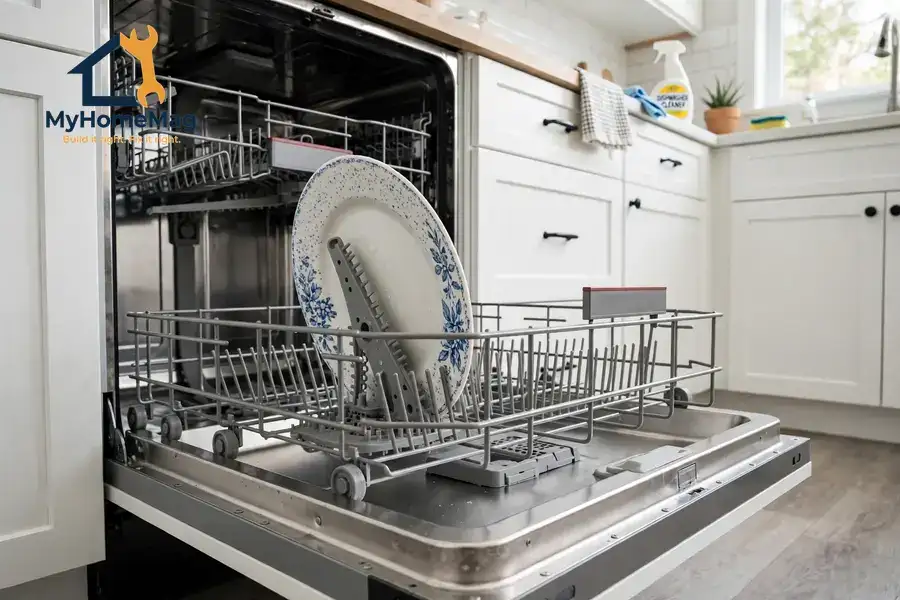
A spray arm blocked by a tall dish can grind as it tries to turn — rearrange the load before suspecting the pump.
The Drain Pump and the Circulation Pump: How to Tell Them Apart
A dishwasher has two pumps, and they make different noises at different times. Knowing which one you are hearing narrows the problem down fast, and it also tells a technician exactly where to look if you call one.
The drain pump moves dirty water out of the machine and into the sink drain or the garbage disposal. It runs at the start of a cycle, to empty the tub, and again at the end, to drain the wash and rinse water. A dishwasher pump making noise only during draining — a grinding or rattling sound that starts when the machine empties and stops when the drain finishes — points to the drain pump. Debris in the drain pump is common, because everything the filter misses ends up there. If the noise is drain-only and the filter is clear, the drain pump is the place to look.
The circulation pump, sometimes called the wash pump, moves water around the tub during the wash and rinse. It runs for most of the cycle, while the spray arms are turning. A grinding or humming noise that lasts through the whole wash phase, and stops during the drain, points to the circulation pump. Debris can reach it too, but wear is more common here, because the circulation pump runs longer and under more load than the drain pump.
The list below summarizes the difference. Use the timing of the noise, not just the sound, to decide which pump you are dealing with.
- Only when the machine drains — Likely source: Drain pump. First thing to check: Filter, then debris in the drain pump.
- Through the whole wash phase — Likely source: Circulation pump or spray arms. First thing to check: Spray arms, then the circulation pump.
- At the very start, before washing — Likely source: Drain pump emptying the tub. First thing to check: Filter and drain pump.
- Constant, from start to finish — Likely source: Motor or circulation pump wear. First thing to check: Filter and spray arms first, then call a pro.
- Only when a certain rack is loaded — Likely source: Spray arm hitting a dish. First thing to check: Rearrange the load, check arm clearance.
- A short rattle, then silence — Likely source: A loose object in the tub. First thing to check: Loose items under the lower rack.
If the noise matches the drain pump row and you have already cleared the filter, the debris is probably in the pump itself. That is the point at which many owners stop and call a technician, because reaching the pump on some models means removing the kick plate or tipping the machine. The checks above the pump are safe home checks; the work below the tub is not always safe
Motor Wear: Signs the Problem Is Bigger
Sometimes the noise is not debris at all. Pumps and motors wear out, and when they do, the sound changes gradually rather than appearing overnight. Motor wear is the cause to consider when the noise has been getting louder over weeks or months, when it continues after the filter, spray arms and pump are all clear, or when it is joined by other symptoms.
The clearest sign of wear is a noise that grows. Debris causes a sudden noise: one day the dishwasher is quiet, the next day it grinds. Wear causes a slow noise: a faint hum that becomes a grind over a few months, a rattle that gets louder each week. If you can remember the noise starting quietly and getting worse, that pattern points to wear, not debris.
Other signs point the same way. A dishwasher that grinds and also washes poorly — dishes coming out dirty, or the spray arms barely turning — may have a circulation pump that can no longer build up pressure. A machine that grinds and drains slowly, even with a clear filter, may have a drain pump whose impeller is worn or cracked. And a machine that hums loudly without the spray arms turning at all may have a motor that is seized or failing to start. In that last case, do not keep running the machine. A seized motor can overheat, and running it will only make the damage worse.

If a dishwasher grinding noise continues after the filter and spray arms are clear, the pump or motor may be worn and a professional should check it.
How Much Does a Repair Cost?
Treat every figure in this section as an approximate US planning range, not a quote, and get a written estimate before authorizing any work. Prices vary by region, by model, and by how much of the machine has to come apart.
- Service call and diagnosis — $75 to $150
- Filter or spray arm replacement (part only) — $20 to $60
- Drain pump replacement, parts and labor — $150 to $350
- Circulation pump replacement, parts and labor — $250 to $500
- Motor replacement, parts and labor — $300 to $600
- Full dishwasher replacement (new mid-range machine, installed) — $500 to $1,000
The cheapest outcome is the most common one: clearing debris from the filter or the pump, which costs nothing if you do it yourself, or a single service call if a technician does it. A spray arm replacement is the next cheapest, and it is a part many owners install themselves. Pump and motor work is where the cost rises, because the parts are expensive and the machine usually has to be pulled out to reach them.
Two things are worth remembering when you weigh a repair. First, a diagnosis fee is often waived or credited if you go ahead with the repair, so ask about that before you book. Second, compare the repair quote with the age of the machine. A $400 pump replacement on a three-year-old dishwasher is usually worth it. The same repair on a twelve-year-old machine, with other parts likely to follow, often is not. A technician can give you an honest view on that, and it is worth asking the question directly.
Safety First: Before You Touch Anything
A dishwasher is a household-current appliance that uses water, and that combination deserves respect. These rules are short, and they apply to every check in this guide.
Turn the power off before you work on the machine. Use the dishwasher’s own switch if it has one, or switch the circuit off at the breaker, and make sure nobody can switch it back on while you are working. Turn the water off at the shut-off valve under the sink as well. The pump and the spray arms cannot hurt you while the power is off — but they can start without warning while the power is on, so never rely on the door switch alone.
Never reach into a running machine. If you want to hear where a noise comes from, do it with the door closed and the machine running its cycle, not with your hand inside the tub. Never reach into the pump housing, the filter housing, or the spray arm mounts while the machine is plugged in or switched on.
Never bypass a safety device. Do not tape down the door switch, jam the float switch, or override any cutoff to make the machine run with the door open or a cover removed. Those devices exist to stop the machine when something is wrong, and bypassing them can cause flooding, electric shock, or injury.
Be careful with broken glass and sharp debris. The most common thing you will find in a filter or a pump is a shard of glass, and it is sharp even when it is small. Wear gloves, use tongs or pliers, and do not reach blindly into a housing you cannot see into. If you cut yourself, stop and deal with the cut before you carry on.
If you smell burning, see smoke, or notice scorching or melted plastic anywhere in or around the machine, stop, turn the power off at the breaker, and do not use the dishwasher again until a professional has looked at it. That is not a debris problem. It is an electrical fault, and it is not safe to investigate at home.
When to Stop and Call a Professional
Some grinding noises are home fixes. Others are not, and knowing the difference saves money and avoids damage. Call a professional if any of the following apply.
The noise continues after you have cleared the filter, checked the spray arms, and removed any debris you could find. That means the cause is deeper in the machine — in the pump or the motor — and reaching it means taking the machine apart.
The impeller will not turn, or it turns with a rough, grinding feel even when it is clear of debris. A damaged or worn impeller needs replacing, and on most models that means removing the pump.
The noise is joined by other symptoms: the dishwasher drains slowly, washes poorly, leaks, or trips the breaker. A combination of faults usually means one component has failed, and a technician can test it properly rather than guessing.
The machine is still under warranty. Opening the machine, removing covers, or replacing parts yourself can void a warranty. If the dishwasher is new enough to be covered, call the manufacturer or the retailer first, and let them arrange the repair.
You smell burning, see smoke, or find scorch marks. Turn the power off at the breaker and do not use the machine again until a professional has inspected it.
The pump or motor is under the machine and you would need to pull the dishwasher out of its housing to reach it. Pulling a dishwasher out means disconnecting the water supply, the drain hose, and the power, and a mistake there can flood a kitchen. That is professional work.
Your Quick Plan
Work through this order if your dishwasher is making a grinding noise:
- Stop the cycle and note when the noise happens: during the wash, during the drain, or all the time. The timing is your best clue.
- With the power off, check the load: remove anything tall or loose that could be touching a spray arm, and check for loose objects under the lower rack.
- Remove the lower rack, twist out the filter, and clear any debris. Rinse the filter, check the housing, and make sure the filter locks back into place.
- Remove the spray arms, shake them, and clear any debris from inside them. Check each arm for cracks or warping, and check that it sits firmly on its mount.
- If your model allows it, look into the drain pump housing with the power still off. Turn the impeller gently by hand — it should spin freely. Remove any debris, but do not force it.
- Run a short empty cycle. If the noise is gone, run one normal load to confirm. If it is still there, stop using the machine and call a professional.
- If you call a pro, tell them when the noise happens and what you have already checked. Ask for a written quote before authorizing a pump or motor replacement, and compare it with the age of the machine.
- To stop it from happening again, scrape plates before loading, check the filter monthly, and keep small hard objects — toothpicks, twist ties, fruit pits, broken glass — out of the dishwasher.
If the noise is joined by a burning smell, smoke, or scorch marks, stop, turn the power off at the breaker, and do not use the machine again until a professional has inspected it.
Frequently Asked Questions
Why is my dishwasher making a grinding noise?
The most common cause is debris — a piece of glass, a bone fragment, a fruit pit or a piece of hard plastic — caught in the filter, the drain pump, or a spray arm. Less often, the cause is a worn drain pump, circulation pump or motor. Check the filter and spray arms first with the power off, and note whether the noise happens during the wash, during the drain, or all the time.
Why does my dishwasher grind only when it drains?
A noise that appears only during draining usually points to the drain pump. The drain pump runs at the start and end of a cycle to empty the tub, and debris that the filter missed often ends up there. Clear the filter first, then look for debris in the drain pump housing with the power off. If the impeller will not turn freely, call a professional.
Can I keep using a dishwasher that makes a grinding noise?
It depends on the cause. If the noise was a loose dish touching a spray arm, or debris you have now removed, the machine is safe to use again — run one empty cycle first to confirm the noise is gone. If the noise continues after the filter and pump are clear, or if it is joined by a burning smell, smoke, or poor washing, stop using the machine and call a professional. Running a worn pump or motor will only make the damage worse.
How much does it cost to fix a dishwasher grinding noise?
Clearing debris from the filter or a spray arm costs nothing if you do it yourself. A professional service call and diagnosis is usually $75 to $150. A drain pump replacement is usually $150 to $350, and a circulation pump or motor replacement is usually $250 to $600, parts and labor included. Treat these as approximate US planning ranges and get a written quote before authorizing work.
Is a grinding noise the same as a dishwasher not draining?
No, although the two can overlap. A dishwasher can grind and still drain, and it can fail to drain without making any noise. Debris that causes grinding can also block a drain, which is why the filter is the first check for both faults. If your dishwasher has standing water in the bottom after a cycle, work through our guide on a dishwasher not draining as well.
When should I call a professional for a dishwasher grinding noise?
Call a professional if the noise continues after you have cleared the filter and spray arms, if the pump impeller will not turn freely, if the noise is joined by slow draining, poor washing, leaking or a tripped breaker, or if you smell burning or see smoke. Also call the manufacturer first if the machine is still under warranty, as opening it yourself can void the cover.
Related Guides
- MyHomeMag
- Appliance Guides
- Dishwasher Not Draining? Causes, Fixes, and When to Call a Pro
- Bosch Dishwasher Not Draining: Causes, Safe Checks, and When to Call a Pro
- Washing Machine Not Draining? Filter, Pump, and Hose Checks
- Dryer Vent Cleaning Cost: What Affects the Quote?
- Dishwasher Not Cleaning Dishes? Spray Arms, Filter, and Loading Fixes
- Dishwasher Leaking From Bottom: Door Gasket vs. Hose Problems



One Response