You open the dishwasher after a full cycle, expecting clean plates, and find the same food still stuck to them. The glasses are cloudy, the bowls have a gritty film, and the top rack looks barely washed. The machine ran, it made all the right noises, and the water drained away at the end — so why is a dishwasher not cleaning dishes?
The short answer is that cleaning needs four things at once: hot water, strong spray, clean water circulating through the filter, and detergent that actually dissolves. When any one of those four is missing, the dishes come out dirty even though the machine itself seems to be working. The good news is that the most common causes are also the cheapest to fix. A blocked filter, a spray arm clogged with food, or plates loaded so tightly that water cannot reach them will make any dishwasher look broken, and all three are fixed in minutes with no parts at all.
A dishwasher not cleaning dishes is usually a blocked filter, clogged spray arms, poor loading, weak detergent, or water that is not hot enough. Clean the filter and the spray-arm holes, load so water can reach every surface, use fresh detergent with rinse aid, and check the water is at least 120°F (49°C) at the faucet. If the dishes are still dirty after those checks, the circulation pump or the heating element may be failing, and that is a technician job.
How a Dishwasher Actually Cleans
A dishwasher does not scrub. It sprays hot, soapy water at the dishes from spinning arms, over and over, for an hour or more. Two spray arms — one under the top rack and one under the bottom rack on most machines — spin as water pressure pushes through their holes. The water hits the dishes, runs down into the sump at the bottom, passes through the filter, and is pumped back up to the arms again.
That loop is why one small blockage causes so much trouble. A filter full of food sends dirty water back onto clean dishes. A spray arm with half its holes blocked sprays weakly on one side and not at all on the other. A tall pan blocking the arm stops it from spinning entirely, and every dish behind it stays dirty. Understanding the loop tells you where to look: start at the filter, then the arms, then the loading, then the water itself.
Common Causes at a Glance
| What you see | Most likely cause | First check |
| Food stuck on most dishes | Blocked filter or clogged spray arms | Check 2, then Check 3 |
| Top rack dirty, bottom rack clean | Top spray arm blocked or not spinning | Check 3 |
| Glasses cloudy or filmy | Hard water, no rinse aid, or too much detergent | Check 4 |
| Gritty residue on everything | Filter full, or detergent not dissolving | Check 2, then Check 4 |
| Dishes dirty only sometimes | Overloading, or tall items blocking an arm | Check 1 |
| Everything dirty and water cold | Water not hot enough, or heating element failing | Check 5 |
Safety First: Before You Touch Anything
Switch the dishwasher off before you reach inside it. If you are removing a spray arm or the filter housing, switch it off at the breaker as well — a cycle starting while your hands are inside is a real risk, and the heating element at the bottom of the tub stays hot long after the cycle ends. Let the tub cool before you touch anything near the bottom.
Do not put bleach, oven cleaner, or any cleaner not made for dishwashers inside the machine. Bleach damages the seals and the stainless steel, and it can react with dishwasher detergent. Do not pour boiling water into the tub to clear a blockage — it can warp plastic parts and crack the seals. If you need to remove a part and it will not come off with a gentle twist or pull, stop. Forcing it breaks the fitting, and a broken spray-arm fitting is a technician repair, not a cleaning job.
Check 1: Loading — the Most Common Cause

Bad loading is the most common reason a dishwasher leaves dishes dirty, and it is also the one people check last. Water can only clean what it can reach. If two plates are pressed together, the water cannot get between them. If a large bowl faces the wrong way, it shields everything behind it. If a tall pan sits in the bottom rack, it can stop the lower spray arm from turning at all.
Load plates so they face the centre of the machine, with a gap between each one. Bowls go angled downwards so water runs off them instead of pooling inside. Cups and glasses go on the top rack, upside down, and never stacked inside each other. Cutlery goes handles down in the basket, except for sharp knives, which go handles up for safety — and never let cutlery nest together in a solid clump, because the pieces in the middle never see the spray.
Before you close the door, spin both spray arms by hand. They should turn freely with a finger push. If an arm catches on a plate or a pan handle, move the item. That five-second check saves a whole wasted cycle. Then run a test load with the machine half full and the dishes spaced out. If a half-full load comes out clean, the machine was never broken — the loading was.
Check 2: The Filter — Five Minutes, No Tools
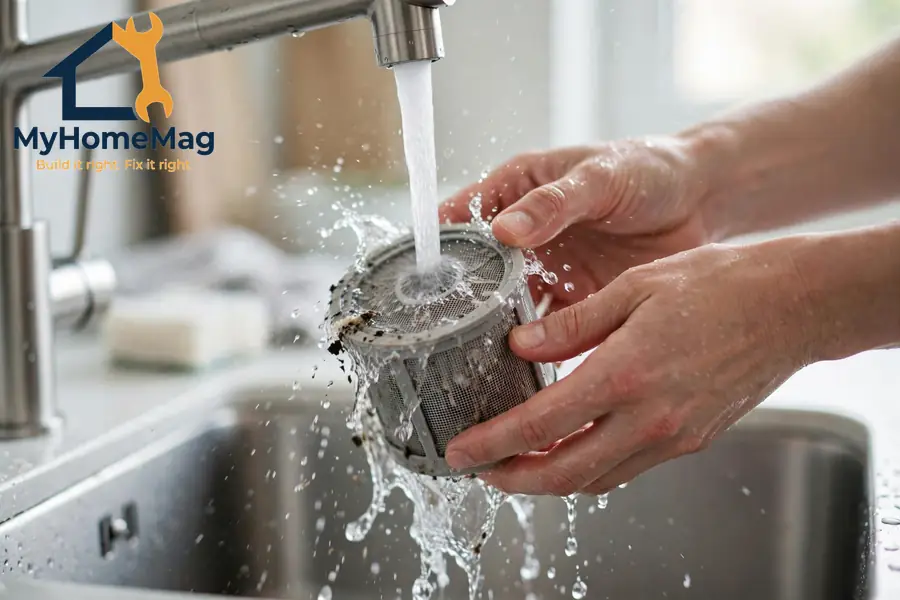
The filter sits in the bottom of the tub, usually a round cylinder under the lower spray arm. Its job is to catch food so it is not sprayed back onto the dishes. When it is full, the water circulating through the machine is dirty, and the dishes come out with a gritty film no amount of detergent will fix.
Twist the filter counterclockwise and lift it out. Rinse it under a running faucet and scrub it gently with an old toothbrush or a soft brush. Check the fine mesh around it as well — a layer of grease there blocks water just as surely as food in the cylinder. If the filter smells, soak it for ten minutes in warm soapy water, then rinse it clean. Never run the dishwasher without the filter in place: food will go straight into the pump, and a blocked pump is a far bigger repair than a dirty filter.
How often you clean it depends on how you use the machine. If you scrape plates before loading, once a month is enough. If food goes in with the plates, check it every week. A filter that is cleaned regularly is the single best habit for keeping dishes clean, and it is the first thing a technician will check — so check it before you call one.
Check 3: The Spray Arms — Small Holes, Big Difference

Each spray arm has a row of small holes, and each one must be open for the arm to spray evenly. Food, limescale, and bits of broken glass block them one at a time, and the arm slowly loses pressure until one whole side of the rack stops getting washed. That is the usual reason the top rack comes out dirty while the bottom rack is fine: the top arm is the one most often blocked, because food falls down through the racks and settles in it.
Remove the lower arm first — it usually lifts off or twists off by hand. Hold it up to the light and look through each hole. Poke any blocked hole clear with a toothpick or a thin piece of wire, then rinse the arm under a faucet and shake it. If you hear something rattling inside, it is a piece of food or glass: keep shaking and rinsing until it comes out. Do the same for the upper arm, which usually unclips or unscrews from the top of the tub.
While the arms are off, check the bearings they spin on. An arm that wobbles or sits crooked sprays sideways instead of up at the dishes. If the bearing is worn or the arm is cracked, the arm itself needs replacing — it is usually a cheap part, and it clips on without tools. Put the arms back, spin them by hand to check they turn freely, and run a test cycle with nothing but a few dirty glasses. If they come out clean, the arms were the problem.
Check 4: Detergent, Rinse Aid, and Hard Water
Detergent goes stale. A box or bottle that has sat open in a damp cupboard for months clumps and loses strength, and a dishwasher pod that has absorbed moisture may not dissolve at all — you will find the pod wrapper still sitting in the dispenser after the cycle. Use fresh detergent, store it somewhere dry, and check the dispenser cup opens during the cycle. If the cup is still shut at the end, the dispenser latch is sticking, and the detergent never reached the dishes.
Use the right amount. More detergent does not mean cleaner dishes: too much leaves a white film on glasses, and in a soft-water area it can etch the glass permanently. Follow the markings in the dispenser, and use one pod rather than a pod plus powder. If your water is hard — white scale on the faucets is the giveaway — add rinse aid to the dispenser and keep it topped up. Rinse aid helps water run off the dishes instead of drying in spots, and it makes the biggest visible difference on glasses.
Run the hot water at the kitchen faucet for a minute before you start the dishwasher. The machine fills with whatever water is in the pipes, and if that water is cold, the first fill is cold — and cold water does not dissolve detergent properly. This one habit fixes a surprising number of “dirty dishes” complaints, and it costs nothing.
Check 5: Water Temperature and the Heating Element
Dishwasher detergent needs hot water to work. Most manufacturers specify at least 120°F (49°C) at the faucet, and the machine then heats it further during the cycle. If the water entering the machine is cold, the detergent dissolves slowly, grease does not lift, and the dishes come out looking barely washed.
Test the temperature with a kitchen thermometer, or simply hold a glass under the hot-water faucet after running it for a minute: it should be too hot to hold comfortably. If the tap water never gets hot enough, check the water heater setting — it may have been turned down — and check whether a long pipe run between the heater and the kitchen is cooling the water on the way. A dishwasher connected to the cold supply by mistake will never clean properly, and that is a plumbing fix, not a dishwasher fault.
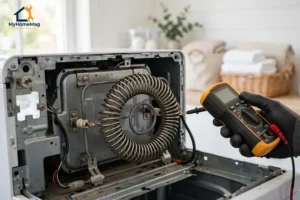
If the water at the faucet is hot but the dishes still come out cold and dirty, the heating element may be failing. You can check it by opening the door mid-cycle — carefully, with the machine switched off first — and feeling whether the tub is hot and steamy. A tub that stays cool through a full cycle points to the element or its thermostat. Both are technician jobs: the element sits under the tub, wired to the mains, and it is not a part to replace yourself.
Check 6: Water Supply, Drain, and When to Call a Pro
A dishwasher that does not fill with enough water cannot clean, however good the spray arms are. If you open the door mid-cycle and the bottom of the tub is barely wet, check the water supply valve under the sink is fully open, and check the inlet hose is not kinked behind the machine. A float switch stuck in the “full” position will also stop the machine filling — it is the small plastic dome in the bottom of the tub, and food under it can hold it up. Lift it gently and clean around it, but do not force it.
Do not confuse this fault with the drain fault in our other dishwasher guides. If water is left standing in the tub at the end of the cycle, that is a draining problem, covered in our guide on a dishwasher not draining — and for Bosch machines, in our Bosch dishwasher not draining guide. If the tub drains fine but the dishes are dirty, the problem is in this article, not those.
Call a professional if any of these apply: the dishes are still dirty after the filter, the spray arms, the loading, the detergent, and the water temperature have all been checked; the tub stays cold through a full cycle; the machine makes a grinding or humming noise while it runs; or water is leaking from underneath the machine. Tell the technician what you have already checked — clean filter, clear spray arms, fresh detergent, hot water at the faucet — so the visit starts with the pump and the element, not with the free checks.
What Repairs Cost, and When Replacement Makes More Sense
Treat every figure as an approximate US planning range, not a quote, and get a written estimate before authorising work.
| Repair | Approximate planning range (installed) |
| Spray arm replacement | $30 to $80 |
| Filter replacement | $20 to $50 |
| Detergent dispenser | $80 to $150 |
| Water inlet valve | $150 to $250 |
| Heating element | $150 to $300 |
| Circulation pump | $250 to $450 |
| Control board | $300 to $500 |
Age matters as much as price. On a dishwasher under eight years old, a spray arm, a filter, or an inlet valve is almost always worth fixing. On a machine over ten years old, a circulation pump or a control board can cost half the price of a new dishwasher, and a new machine will also use less water and less energy. If a technician quotes more than half the cost of a comparable new dishwasher, ask for the numbers in writing before deciding.
Preventing Dirty Dishes in the Future
Three habits keep a dishwasher cleaning well. Scrape plates before loading — the machine is not a waste disposal unit, and food in the filter is the fastest route back to dirty dishes. Clean the filter once a month and check the spray-arm holes whenever you do it. And keep rinse aid topped up, especially in a hard-water area, so water runs off the glasses instead of drying on them.
Run the machine regularly, too. A dishwasher left unused for weeks can develop smells, stuck seals, and a pump that struggles to start. If you go away, run a short empty cycle when you return before you load it with dishes. And never overload it to save a cycle: one full load that comes out dirty costs two cycles to fix, and it costs more water and detergent than two properly loaded cycles.
Your Quick Plan
If your dishwasher is not cleaning dishes, work through this order and stop as soon as the dishes come out clean:
- Load a half-full test load with gaps between the plates, and spin both spray arms by hand before closing the door.
- Remove the filter, rinse it, scrub the mesh, and put it back properly.
- Take off both spray arms, clear every hole with a toothpick, rinse them, and check they spin freely.
- Use fresh detergent, top up the rinse aid, and run the hot-water faucet for a minute before starting the cycle.
- Check the water at the faucet is at least 120°F (49°C), and feel whether the tub is hot and steamy mid-cycle.
- Check the supply valve is fully open and the float switch moves freely.
If the dishes are clean after any step, run one full normal load to confirm the fix. If they are still dirty after all six steps, call a technician with the machine’s make and age and the checks you already tried.
Frequently Asked Questions
Why is my dishwasher not cleaning the top rack?
The top rack is washed by the upper spray arm, and it is the arm most often blocked — food falls down through the racks and settles in its holes. Remove the upper arm, clear every hole with a toothpick, rinse it, and check it spins freely. Also check that a tall item in the bottom rack is not blocking the arm from turning.
Why are my glasses cloudy after the dishwasher?
Cloudy glasses are usually hard water, too much detergent, or no rinse aid. Keep the rinse aid dispenser topped up, use the amount of detergent marked in the dispenser — not more — and run the hot-water faucet before starting the cycle. If the cloudiness does not wipe off with vinegar, the glass may be etched, and etching is permanent.
Should I rinse dishes before putting them in the dishwasher?
Scrape food off, but do not rinse dishes clean. Dishwasher detergent needs something to work on, and a fully rinsed plate can actually come out dirtier because the detergent has nothing to grip. Scrape off the solids, leave the rest, and let the machine do its job.
Why is there grit on my dishes after the cycle?
Grit is almost always a full filter. Food trapped in the filter is pumped back onto the dishes with the wash water. Remove the filter, rinse it under a faucet, scrub the mesh, and clean it monthly. Never run the machine without the filter in place.
When should I call a professional for a dishwasher that does not clean?
Call a professional if the dishes are still dirty after you have cleaned the filter and the spray arms, fixed the loading, used fresh detergent, and confirmed hot water at the faucet — or if the tub stays cold through a cycle, the machine grinds or hums, or water leaks underneath it. Those point to the circulation pump, the heating element, or a leak, and they are technician jobs.
Related Guides
- MyHomeMag
- Appliance Guides
- Dishwasher Not Draining? Causes, Fixes, and When to Call a Pro
- Bosch Dishwasher Not Draining? Causes, Safe Checks, and When to Call a Pro
- Washing Machine Leaking: Find the Source, Stop the Water, and Fix It Safely
- Dryer Not Heating? Electric and Gas Checks to Try First